
Kelly Coughlin, CPA
Financial Clarity for Small Business Owners

Financial Clarity for Small Business Owners: What It Actually Means and Why Most Entrepreneurs Never Get It
Most business owners do not actually have a bookkeeping problem.
They have a financial clarity problem.
That distinction matters.
A bookkeeping problem sounds like something you solve by entering more transactions, cleaning up QuickBooks, hiring a bookkeeper, creating another spreadsheet, or finally “getting organized.”
Sometimes those things help. But they do not automatically give you clarity.
Financial clarity means you understand what is happening in your business well enough to make confident decisions. You know where money is going. You know whether the business is actually profitable. You know what tax surprises might be coming. You know whether growth is helping you or just creating more stress.
You do not need to become an accountant to get that kind of clarity.
And you should not have to.
Most business owners did not start their business because they wanted to reconcile bank accounts, decode balance sheets, categorize expenses, or learn accounting software. They started because they had a service to provide, a product to sell, a skill to monetize, a team to build, or a better way to serve customers.
Then the financial side became heavier than expected.
Revenue comes in, but profit is unclear. The bank account has money, then suddenly it does not. QuickBooks has reports, but the reports do not answer the questions you actually care about. Tax season arrives, and once again, you feel like you are reacting instead of planning.
That is not a sign you are bad at business.
It is a sign your financial system is not giving you the visibility you need.
The goal is not better bookkeeping. The goal is better decisions.
If your numbers feel overwhelming, you are not alone. Book a call with Kelly or Cat and let’s talk through what financial clarity could look like for your business.

What Financial Clarity Actually Means
Financial clarity means knowing what is happening in your business in plain English.
Not accounting language. Not spreadsheet language. Not tax software language. Plain English.
It means you can answer questions like:
Where is the money going?
What did the business actually make?
What expenses are growing too fast?
What should I set aside for taxes?
Can I afford to hire?
Can I afford to pay myself more?
Are my prices high enough?
Which services, customers, or projects are profitable?
Is my cash flow stable?
Am I building wealth, or just staying busy?
Financial clarity is not the same as having reports.
A profit and loss statement is not automatically clarity. A QuickBooks file is not automatically clarity. A spreadsheet is not automatically clarity. A bank balance is definitely not clarity.
Financial clarity happens when your financial information is organized, reviewed, translated, and connected to decisions.
That last part is important.
A business owner does not need reports for the sake of reports. A business owner needs answers.
Reports should help you decide what to do next.
Financial Clarity Means Knowing Where Money Is Going
Many owners have a general sense of revenue but a weak sense of spending.
They know sales were good this month. They know the bank account looked healthy. But they cannot easily explain why cash got tight, why profit was lower than expected, or why the business feels stressful even when revenue is up.
Financial clarity gives you a clean view of spending patterns.
Not just “expenses were high.” More useful questions include:
Which expenses are fixed?
Which expenses are rising?
Which costs are tied directly to revenue?
Which expenses are discretionary?
Which subscriptions, tools, or vendors are no longer useful?
Which costs are silently becoming normal?
A business can leak money slowly without any single expense looking dramatic.
Financial clarity helps you see the pattern.
Financial Clarity Means Understanding Profitability
Revenue feels good.
Profit matters more.
One of the most common problems for growing businesses is confusing activity with profitability. The owner is busy. Sales are coming in. Customers are paying. The business looks successful from the outside.
But inside, the owner feels pressure.
There is not enough cash. Taxes are a surprise. Payroll feels tight. Credit cards carry balances. The owner is not paying himself or herself consistently. Growth creates more work but not more freedom.
Financial clarity helps answer the uncomfortable but necessary question:
Is this business actually making money in a way that supports the owner?
Not just gross revenue. Not just deposits. Real profitability.
Financial Clarity Means Tax Awareness Before Tax Season
Tax surprises are one of the clearest signs of poor financial visibility.
A business owner should not have to wait until March or April to find out whether the year went well, whether taxes were underpaid, or whether the business missed planning opportunities.
Financial clarity includes tax awareness throughout the year.
That does not mean you need to know every tax rule. It means you should have a practical sense of:
Whether profit is rising
Whether estimated taxes are on track
Whether deductions are being captured
Whether owner pay is being handled correctly
Whether major purchases should be planned before or after year-end
Whether your business structure still makes sense
Tax planning is much more useful before the year is over.
After the year ends, many decisions are already locked in.
For practical tax guidance, you can also download the free Tax Tips & Hacks book.

Financial Clarity Means Knowing What Matters
Business owners are drowning in data.
Bank feeds. Apps. Reports. Dashboards. Payment processors. Payroll systems. Invoices. Credit cards. Spreadsheets. Tax forms. QuickBooks categories. Profit and loss statements.
The problem is not always lack of information.
Sometimes the problem is too much information with too little interpretation.
Financial clarity helps separate signal from noise.
You do not need to track everything with equal intensity. You need to know which numbers matter for your business right now.
For one owner, the key issue may be gross margin. For another, it may be cash flow timing. For another, it may be owner compensation. For another, it may be tax reserves. For another, it may be pricing.
Financial clarity is not about staring at more numbers.
It is about understanding the right numbers.
Why Most Business Owners Lack Financial Clarity
Most business owners lack financial clarity for understandable reasons.
They are not lazy. They are not careless. They are usually busy, under-supported, and stuck with financial systems that were not designed around how owners actually think.
1. They Were Never Trained to Read Their Numbers
Most owners were trained in their craft, profession, trade, or industry.
They were not trained to read a balance sheet. They were not trained to understand cash versus profit. They were not trained to interpret owner draws, payroll liabilities, tax reserves, debt payments, or gross margin trends.
Then they start a business and suddenly all of that matters.
The result is a quiet kind of shame.
Many owners think, “I should understand this better.”
But why would they? Nobody taught them.
And most accounting reports are written for accountants, lenders, tax preparers, or software systems — not for busy owners trying to make practical decisions.
2. Their Bookkeeping Is Inconsistent
Financial clarity requires clean inputs.
If transactions are misclassified, accounts are not reconciled, business and personal expenses are mixed, or QuickBooks has duplicate entries, the reports become unreliable.
And once the owner stops trusting the reports, the entire system starts to break down.
The owner may still have bookkeeping.
But bookkeeping without trust does not create clarity.
It creates noise.
If your books are messy, start with QuickBooks Cleanup & Rescue. You can also read our guide on common QuickBooks bookkeeping mistakes.
3. Their CPA Relationship Is Tax-Only
Many business owners have a CPA who appears once a year.
The CPA prepares the tax return, asks for missing documents, files the return, and disappears until next year.
That may be enough for simple compliance.
It is not enough for financial clarity.
A tax-only relationship usually looks backward. It answers, “What happened last year?”
Business owners need more than that.
They need help understanding what is happening now and what should happen next.
4. QuickBooks Is Used as a Storage System Instead of a Decision System
Many owners use QuickBooks as a place where transactions go until tax season.
That is understandable.
But if the system is only reviewed at year-end, it cannot help you make better decisions during the year.
QuickBooks can record activity.
It does not automatically turn activity into insight.
The software may tell you what was categorized.
It may not tell you what matters.
5. They Confuse Cash in the Bank With Business Health
Cash in the bank is important.
But it is not the full story.
A business can have cash today and still be heading toward a tax problem, debt problem, margin problem, payroll problem, or seasonal cash flow problem.
A business can also have low cash temporarily and still be fundamentally healthy.
Financial clarity requires context.
The bank account is one signal.
It is not the whole dashboard.
6. They Are Reacting Instead of Reviewing
Many business owners only look closely at finances when something goes wrong.
A tax bill arrives. Payroll is tight. A credit card balance is too high. A lender asks for financial statements. A bookkeeper quits. A customer does not pay. A surprise expense hits.
That reactive cycle is exhausting.
Financial clarity creates a habit of review before crisis.
Signs You Do Not Have Financial Clarity
Lack of financial clarity usually shows up as a feeling before it shows up as a report.
You feel uneasy. You avoid logging in. You hesitate before making decisions. You know revenue is coming in, but you are not sure whether the business is truly healthy.
Here are common signs.
You Avoid Looking at the Numbers
Avoidance is not a character flaw.
It is often a signal that the system feels confusing, judgmental, or overwhelming.
If opening QuickBooks creates anxiety, the problem may not be your discipline. The problem may be that the numbers are not organized in a way that gives you confidence.
A good financial system should reduce stress.
If your system increases stress every time you open it, something is wrong.
You Do Not Know Whether You Are Actually Profitable
You may know your revenue. You may know your bank balance. You may know roughly what came in this month.
But can you confidently explain profit?
Can you explain whether profit improved or declined? Can you explain whether one service line is carrying the business while another quietly drains it? Can you explain whether your owner pay is sustainable?
If not, you may have financial activity but not financial clarity.
Tax Season Surprises You
A tax surprise does not always mean something was done wrong.
But repeated tax surprises usually mean there is not enough visibility during the year.
You should not find out after year-end that profit was much higher than expected, deductions were missed, estimated tax payments were too low, or cash was not reserved.
Financial clarity does not eliminate taxes.
It reduces surprises.
Cash Flow Feels Unpredictable
Cash flow confusion is one of the most stressful parts of running a business.
You may have a strong sales month and still feel cash pressure. You may collect money but immediately lose it to payroll, vendors, debt, taxes, or owner draws.
You may not know whether tight cash is a temporary timing issue or a deeper profitability problem.
Financial clarity helps separate those issues.
That distinction matters because the solutions are different.
You Guess When Making Decisions
Should you hire? Raise prices? Buy equipment? Cut a service? Take on debt? Pay yourself more? Offer discounts? Move to a bigger office?
Without financial clarity, these decisions become guesses.
Many business owners rely on instinct because they do not trust the numbers.
Instinct matters. Owners often have good instincts.
But instinct works better when it is supported by clear financial information.
Revenue Grows, but Stress Grows Too
Growth is supposed to make the business stronger.
But growth without clarity can make the business more stressful.
More sales can mean more expenses, more payroll, more receivables, more inventory, more tax exposure, more debt, more complexity, and more risk.
Some businesses grow themselves into cash flow problems.
Financial clarity helps you understand whether growth is healthy.
Not all revenue is good revenue.
Your Reports Do Not Answer Your Real Questions
A report may be technically correct and still not useful.
You may have a profit and loss statement but still not know what to do. You may have a balance sheet but not understand what it is telling you. You may have a cash flow report but not know which decisions should change.
Financial clarity means reports are translated into business meaning.
Recognizing the problem is the first step. The next step is getting a clear view of what is actually happening. Book a financial clarity conversation .

The Hidden Cost of Financial Confusion
Financial confusion is expensive.
Not always immediately.
But over time, it affects taxes, cash flow, growth, pricing, stress, and the owner’s ability to build wealth.
Bad Decisions
When the numbers are unclear, decisions get made with incomplete information.
You may hire too soon. Wait too long to hire. Underprice services. Keep unprofitable customers. Cut marketing that was actually working. Spend money because the bank account looks healthy. Avoid investments that the business could afford.
Financial confusion does not always cause dramatic failure.
Sometimes it simply causes slow, expensive drift.
Overpaying Taxes
Poor financial visibility can lead to missed deductions, weak documentation, bad timing, and lack of planning.
Many owners think tax savings happen at tax filing.
Some do.
But the better opportunities often come earlier: entity structure, retirement planning, owner compensation, timing of income and expenses, accountable plans, clean documentation, estimated tax planning, and strategic review before year-end.
Without financial clarity, tax planning becomes reactive.
Reactive tax planning is limited.
Cash Flow Mistakes
Cash flow mistakes happen when owners mistake deposits for available money.
A $30,000 deposit may feel like money available to spend.
But part of that may need to cover payroll, sales tax, income tax, subcontractors, software, debt service, insurance, or upcoming obligations.
Financial clarity helps you avoid spending money twice in your mind before it leaves the bank.
Pricing Problems
Pricing is one of the most important financial decisions in a business.
But many owners set prices based on market pressure, fear, competitors, or habit.
Without clarity, you may not know your true cost to deliver the work. You may not know which customers are profitable. You may not know whether discounts are killing your margin. You may not know whether a “good client” is actually good financially.
Financial clarity helps connect pricing to reality.
Burnout
Financial confusion creates mental load.
The owner carries questions in the background:
Can I afford this?
Am I behind?
What will taxes look like?
Why is cash tight?
Is the business working?
What am I missing?
That uncertainty is exhausting.
Clarity does not solve every problem.
But it reduces the emotional weight of not knowing.
Slower Growth
Businesses grow faster and healthier when the owner can make decisions confidently.
Financial confusion slows that down.
The owner hesitates, delays, reacts, and avoids. Opportunities get missed because the numbers are not ready. Problems get addressed late because the warning signs were not visible.
Clarity speeds up decision-making.
Financial Clarity vs. Bookkeeping
This is the most important distinction.
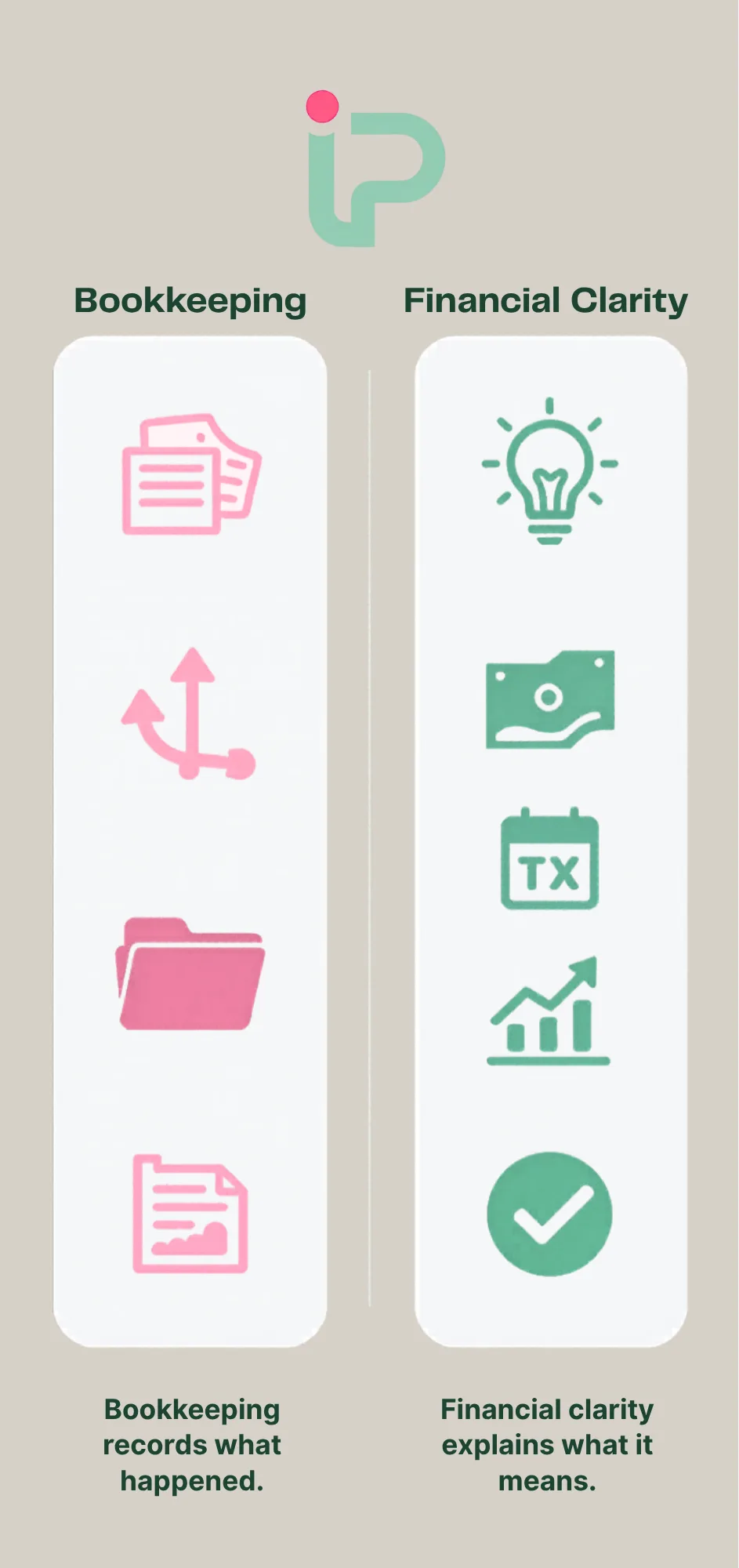
Bookkeeping records what happened. Financial clarity explains what it means.
Bookkeeping is necessary. It creates the raw material. Transactions need to be categorized. Accounts need to be reconciled. Reports need to be accurate.
But bookkeeping alone is not the destination.
A business owner can have bookkeeping and still not understand the business.
That happens all the time.
The books may be current, but the owner still does not know:
Whether profit is strong enough
Whether cash flow is safe
Whether taxes are on track
Whether pricing is working
Whether expenses are too high
Whether the business is building wealth
That is because bookkeeping is historical.
It tells you what happened.
Financial clarity connects the past to the next decision.
Why Businesses Confuse the Two
Bookkeeping is tangible.
You can see transactions. You can check reconciliations. You can produce reports.
Financial clarity is more interpretive.
It requires someone to look at the numbers and ask, “So what?”
So what does this mean for taxes? So what does this mean for cash? So what does this mean for hiring? So what does this mean for pricing? So what does this mean for the owner?
That “so what” is where the value lives.
The Owner Does Not Need More Accounting Work
Many owners think the answer is to get better at bookkeeping.
Sometimes they do need better habits.
But often, the owner does not need more accounting work.
The owner needs a system that turns financial activity into useful answers.
That may include bookkeeping.
But the point is clarity.
You may not need more accounting work. You may need better answers. Talk with Kelly or Cat.

Financial Clarity vs. QuickBooks
QuickBooks can be useful.
It is widely used, familiar, and often a good starting point. For many businesses, QuickBooks is part of the solution.
But software is not clarity.
Software is a tool.
A tool can help collect, organize, and report information. But a tool does not automatically know what matters in your business. It does not understand your goals. It does not know whether you are trying to hire, save for taxes, improve margins, prepare for financing, or reduce owner stress.
QuickBooks can show you reports. It may not explain what the reports mean.
QuickBooks can import transactions. It may not know whether those transactions are categorized correctly.
QuickBooks can show profit. It may not explain why cash is tight.
QuickBooks can track activity. It may not help you decide what to do next.
That is not an attack on QuickBooks.
It is a realistic understanding of what software can and cannot do.
The business owner does not need to worship the tool.
The business owner needs the outcome.
The EverydayCPA Financial Clarity Framework
Financial clarity does not happen by accident.
It comes from a system.
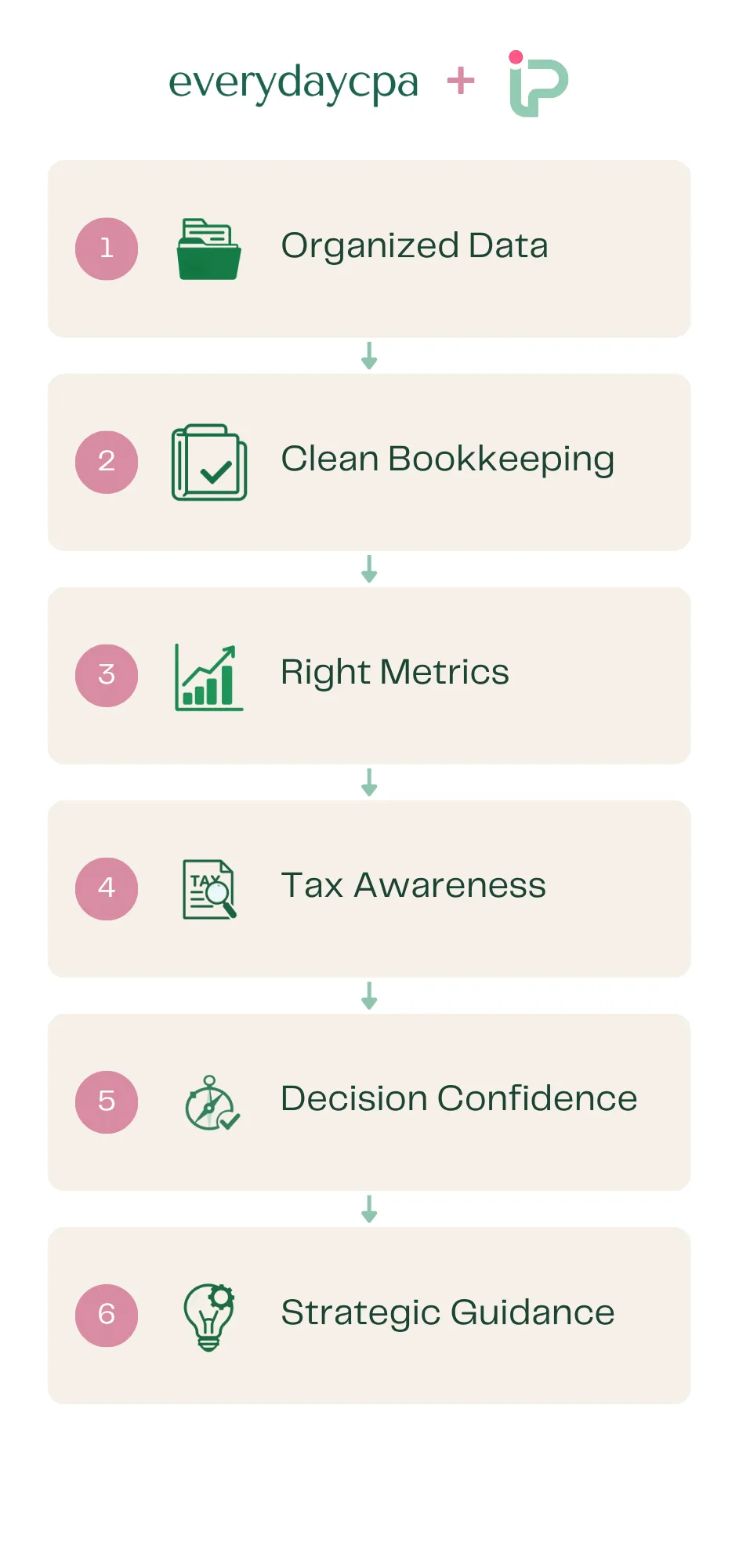
At EverydayCPA, we think about financial clarity in six layers.
Layer 1: Organized Financial Data
Everything starts with clean inputs.
That means bank accounts, credit cards, payment processors, payroll systems, loans, invoices, receipts, and tax documents need to be collected and organized.
If the underlying data is scattered, incomplete, or mixed between business and personal activity, clarity becomes harder.
The goal at this stage is not deep analysis.
The goal is to make sure the financial picture is complete enough to trust.
Layer 2: Clean Bookkeeping
Once the data is organized, the books need to be accurate.
That means transactions are categorized correctly, accounts are reconciled, duplicates are removed, owner payments are handled properly, and the balance sheet makes sense.
Clean bookkeeping creates the foundation.
Without it, financial clarity becomes guesswork.
But clean books are still not the finish line.
They are the starting point for better decisions.
Layer 3: Visibility Into the Right Metrics
Not every number deserves equal attention.
The right metrics depend on the business.
A service business may need to watch labor cost, utilization, margins, cash reserves, and owner compensation. A contractor may need job profitability, materials, subcontractor costs, retainage, and cash flow timing. A professional service firm may need recurring revenue, effective hourly rates, receivables, and tax reserves.
Financial clarity means identifying the numbers that actually matter.
Layer 4: Tax Awareness
Taxes should not be a once-a-year surprise.
A clarity-focused financial system keeps tax issues visible throughout the year.
This includes estimated taxes, entity structure, deductions, owner compensation, retirement planning, state tax issues, and year-end planning opportunities.
Tax awareness does not mean obsessing over taxes.
It means avoiding unnecessary surprises.
Layer 5: Decision-Making Confidence
Financial clarity should make decisions easier.
The owner should be able to look at the numbers and understand what choices are reasonable.
Can we hire? Should we raise prices? Can we invest in marketing? Should we reduce expenses? Should we change how the owner is paid? Should we pursue growth or stabilize first?
Good financial information should create confidence, not confusion.
Layer 6: Strategic Guidance
Most business owners benefit from having someone help interpret the numbers.
Not because they are incapable.
Because they are busy and close to the business.
A good advisor helps translate financial data into practical decisions.
The best financial guidance is not just technical.
It is contextual.
It considers taxes, cash flow, operations, goals, risk, owner stress, and long-term wealth.
What Financial Clarity Helps You Decide
Financial clarity is practical.
It should help with real decisions.
Can I Afford to Hire?
Hiring is one of the biggest decisions a small business owner makes.
Without clarity, hiring can feel like a gamble.
You need to understand cash flow, recurring revenue, current workload, profit margins, payroll taxes, benefits, training time, and whether the role should produce revenue or reduce owner burden.
Financial clarity does not make hiring risk-free.
It makes the risk visible.
Should I Raise Prices?
Many owners underprice because they do not fully understand their costs.
They know what competitors charge. They know what customers are used to paying. But they do not know the true cost of delivering the work.
Financial clarity helps connect pricing to profit.
Sometimes the answer is not more customers.
Sometimes the answer is better pricing.
How Much Should I Set Aside for Taxes?
This is one of the most practical clarity questions.
The answer depends on profit, entity type, owner compensation, estimated tax payments, deductions, state taxes, and prior-year patterns.
Without clarity, owners either save too little and panic later, or save too much and unnecessarily restrict cash.
A good system helps create a reasonable tax reserve strategy.
Is Growth Actually Helping?
Growth can hide problems.
Revenue may rise while margins fall. The team may expand while owner income does not. More customers may create more stress but not more profit.
Financial clarity helps determine whether growth is healthy, profitable, and sustainable.
Growth should make the business stronger.
Not just bigger.
Where Is the Money Going?
This question sounds simple.
It is not.
Money can disappear into payroll, contractors, debt, taxes, subscriptions, inefficient operations, underpriced work, owner draws, uncollected invoices, or seasonal timing issues.
Financial clarity helps trace the path of cash so the owner can make better decisions.
How EverydayCPA Approaches Financial Clarity
EverydayCPA is not trying to be a traditional accounting firm that only prepares reports and tax returns.
We are focused on outcomes.
That means helping business owners get from financial confusion to financial clarity.
The work may include bookkeeping, cleanup, tax planning, reporting, advisory conversations, QuickBooks review, or broader financial organization.
But the purpose is bigger than accounting tasks.
The purpose is to help the owner understand the business.
We want business owners to know what is happening, what matters, what risks exist, what opportunities may be available, and what decisions should come next.
That is why our approach is practical.
We do not believe business owners should be buried in jargon.
We do not believe a report is useful just because it is technically correct.
We do not believe owners should have to become accountants to get control of their finances.
We believe the financial system should serve the owner.
Not the other way around.
We work with owners remotely and locally through our Kansas City CPA and Fort Lauderdale CPA teams.
Where iPacio Fits
At some point, many business owners stop wanting better accounting tools.
They start wanting better clarity.
That is the shift iPacio is built around.
iPacio is designed to remove accounting as an operational burden and move the owner closer to the outcome that actually matters: understanding the business.
The traditional path often looks like this:
Business owner → accounting software → bookkeeping → reports → confusion → tax season stress
A better path looks like this:
Business owner → organized data → clear insight → tax awareness → confident decisions
The point is not to make business owners do more accounting.
The point is to help them get the answers accounting was supposed to provide.
That is the future EverydayCPA is building toward: financial clarity without forcing owners to live inside accounting software.
QuickBooks may still play a role for some businesses. Bookkeeping still matters. Tax preparation still matters.
But the owner’s goal is not to become excellent at bookkeeping.
The owner’s goal is to run a stronger business with less financial stress.
See how EverydayCPA and iPacio help business owners move from accounting stress to financial clarity. Learn about iPacio.
How to Start Getting Financial Clarity
Financial clarity can feel big, but the first steps are usually simple.
Start with the questions that matter most:
Do you trust your numbers?
Are your accounts reconciled?
Do you know your actual profit?
Do you know what taxes might look like?
Do you know where cash is going?
Do your reports help you make decisions?
Do you feel more confident after looking at your financials, or more confused?
The answers will tell you where to begin.
For some owners, the first step is QuickBooks cleanup. For others, it is catch-up bookkeeping. For others, it is a tax planning conversation. For others, it is building a reporting system that finally explains the business in plain English.
The important thing is not to stay stuck.
Financial confusion usually gets heavier the longer it sits.
Financial clarity is usually closer than people think.
You Do Not Need to Become an Accountant
Messy numbers do not mean you are bad at business.
Confusing reports do not mean you are irresponsible.
Avoiding QuickBooks does not mean you do not care.
Most business owners feel overwhelmed by finances because they were handed systems that record data but do not create clarity.
You do not need more shame.
You need a better way to see what is happening.
Financial clarity gives you confidence. It helps you make better decisions. It reduces tax surprises. It makes growth less chaotic. It helps you feel in control again.
And you do not have to figure it out alone.
Book a call with Kelly or Cat and let’s talk through what clarity could look like for your business.
FAQ: Financial Clarity for Small Business Owners
What is financial clarity for small business?
Financial clarity for small business means understanding what is happening financially in your business so you can make confident decisions. It includes visibility into cash flow, profitability, taxes, expenses, financial risks, and growth opportunities.
Why is financial clarity important for business owners?
Financial clarity helps business owners make better decisions, avoid tax surprises, manage cash flow, improve profitability, and reduce financial stress. Without clarity, owners often guess when making important decisions.
Is financial clarity the same as bookkeeping?
No. Bookkeeping records financial activity. Financial clarity explains what that activity means. Bookkeeping is the foundation, but clarity comes from reviewing, interpreting, and using the numbers to make decisions.
Can QuickBooks give me financial clarity?
QuickBooks can help organize financial information, but software alone does not create clarity. Financial clarity requires accurate data, clean bookkeeping, useful reporting, tax awareness, and interpretation.
How do I know if I lack financial clarity?
You may lack financial clarity if you avoid looking at your numbers, do not know whether you are profitable, experience tax surprises, struggle with cash flow, guess when making decisions, or do not trust your financial reports.
What causes financial confusion in small businesses?
Financial confusion is often caused by messy bookkeeping, unclear reports, inconsistent financial processes, tax-only accounting relationships, poor cash flow visibility, and too much data without enough interpretation.
How can I improve financial clarity?
Start by organizing financial data, cleaning up bookkeeping, reconciling accounts, reviewing key reports monthly, tracking cash flow, estimating taxes throughout the year, and working with an advisor who can translate numbers into decisions.
What is the difference between profit and cash flow?
Profit shows whether the business earned more than it spent over a period of time. Cash flow shows how money moves in and out of the business. A business can be profitable and still have cash flow problems.
Why does revenue go up while stress increases?
Revenue growth can increase stress if expenses, payroll, taxes, debt, or operational complexity grow at the same time. Financial clarity helps determine whether growth is profitable and sustainable.
Can EverydayCPA help me get financial clarity?
Yes. EverydayCPA helps business owners clean up financial records, understand their numbers, plan for taxes, improve visibility, and make better financial decisions without becoming accountants.
Ready to See Your Numbers Clearly?
You do not need to become an accountant to run a successful business.
You need clean numbers, tax awareness, and practical guidance you can actually use.
Book a call with Kelly or Cat (/book-a-cpa), or explore iPacio (/ipacio) to see how EverydayCPA can help you move from financial confusion to financial clarity.