
Kelly Coughlin, CPA
Financial Reports vs. Reality: Turn Data Into Decisions
Your accounting software can produce a profit and loss statement, balance sheet, cash flow statement, accounts receivable report, sales dashboard, expense report, budget comparison, and a dozen colorful charts.
And after opening all of them, you may still have no idea whether you can safely hire someone.
That is the strange problem with modern financial reporting: getting data has become easy. Turning that data into a confident decision has not.
You can have clean charts and unanswered questions. You can have a profitable P&L and a tight bank account. You can have record sales and shrinking margins. You can have a dashboard full of green arrows while overdue invoices quietly consume your available cash.
The answer is not another report.
It is a better path from business activity to financial clarity.
A Report Is an Answer to One Particular Question
Every financial report has a job.
An income statement shows revenue, expenses, and profit over a period. A balance sheet shows what the business owns, what it owes, and its equity at a point in time. A cash flow statement explains how cash moved through operating, investing, and financing activities.
The SEC’s plain-English guide emphasizes that these reports are related but not interchangeable. Cash flow is not the same as net income, and no single financial statement tells the complete story.
Trouble begins when an owner asks one report to answer a question it was not designed to answer.
“Did we earn a profit?” is not the same question as “Can we cover payroll, taxes, and vendor bills next month?”
“Did revenue increase?” is not the same as “Did the new sales produce enough margin to justify the added labor?”
“How much cash is in the bank?” is not the same as “How much of that cash is actually available after near-term obligations?”
A report may be accurate and still be too narrow for the decision in front of you.
That is the difference between reports and reality.
How Business Activity Becomes a Decision
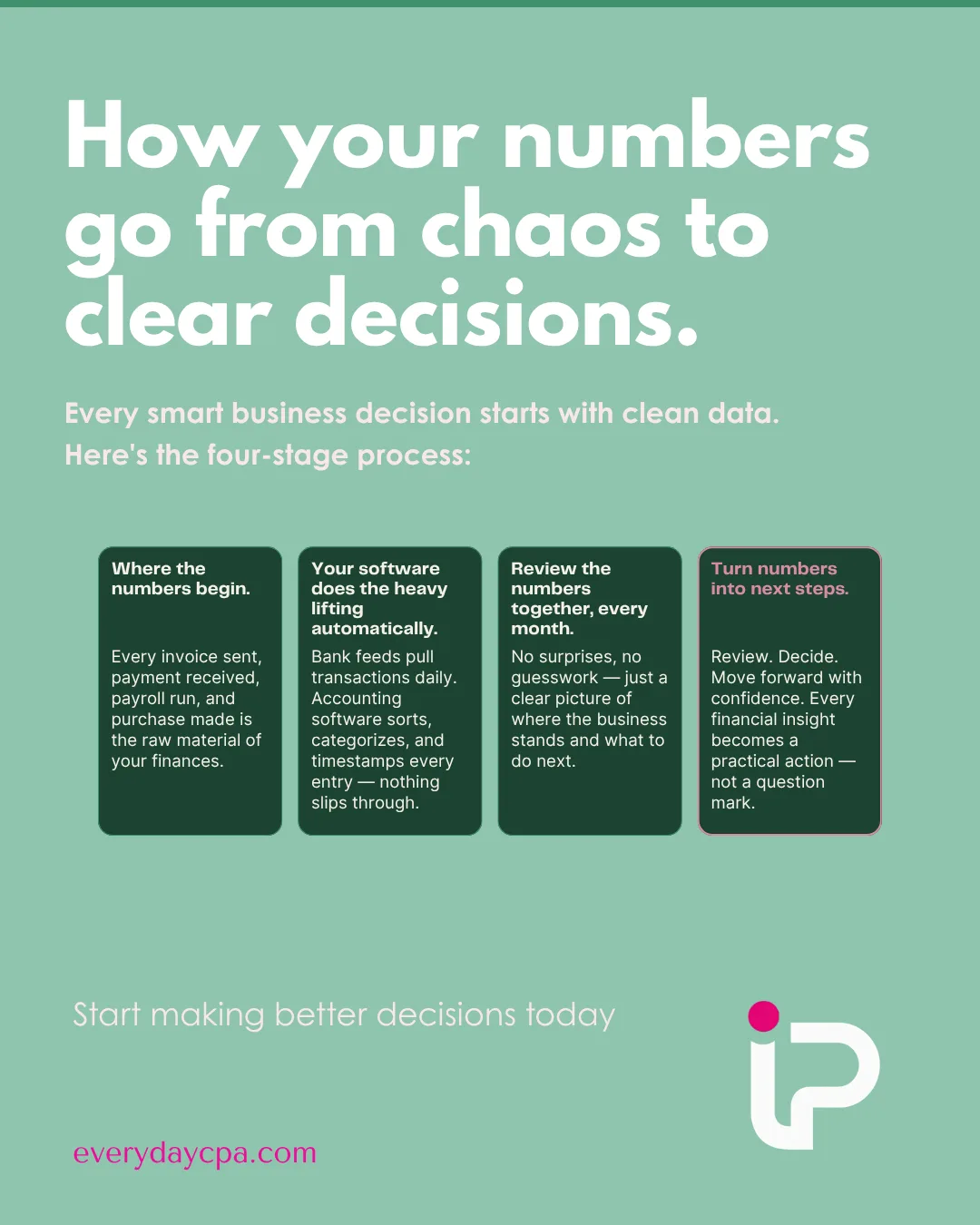
Useful financial information passes through four stages.
1. Something Happens in the Business
You complete a project. A customer pays an invoice. An employee works overtime. You purchase equipment. A vendor raises its price. A client disputes a bill.
That event is the reality.
The owner usually understands its business purpose. But that context does not automatically appear in the accounting records.
2. Technology Records and Organizes the Activity
Bank feeds, accounting software, payroll systems, payment processors, and automation tools collect the data. They may match transactions, suggest categories, calculate totals, and generate reports.
This stage is valuable. It reduces manual work and gives structure to thousands of separate transactions.
But organized data is not necessarily correct data.
A transfer can be mistaken for revenue. Equipment can be treated like an ordinary expense. A customer deposit can appear to be earned income. One vendor can be classified differently from month to month.
Technology can produce a polished report from flawed assumptions.
That is why clean-looking reports are not always reliable or tax-ready.
3. Human Review Makes the Numbers Trustworthy
Someone must reconcile the accounts, investigate unusual activity, apply consistent definitions, consider the accounting method, and ask the owner what actually happened.
This is where bookkeeping becomes more than data entry.
The reviewer may discover that:
Revenue increased because one annual contract was invoiced early.
Labor costs rose because the team corrected avoidable rework.
Cash fell because debt principal and equipment purchases do not appear as ordinary P&L expenses.
Receivables grew because one major customer changed its payment process.
A strong bank balance includes tax money and customer deposits that should not be spent.
These are not merely accounting details. They change the decision.
4. Applied Analysis Produces an Action
The final stage answers three questions:
What changed?
Why did it change?
What should we do next?
Without that stage, reporting stops too early.
The report may be complete. The accounting work is not.
Why Accurate Reports Still Fail Business Owners
Some reports are wrong because the underlying books are wrong. But even technically correct reports can fail you.

The Report Arrives Too Late
A beautifully prepared report delivered six weeks after month-end may document a problem after the useful response window has closed.
Timeliness depends on the decision. Last month’s closed financial statements can support a strategic review. They may not help with Friday’s payroll decision.
The Number Has No Comparison
Revenue of $90,000 sounds encouraging until you learn that:
The budget was $110,000.
The same month last year produced $98,000.
Direct labor rose 30%.
One customer generated half the total.
A number without a comparison is an observation, not an interpretation.
Compare important results with a relevant baseline: the prior period, the same seasonal period, the budget, the forecast, or a consistently defined operating target.
The Report Shows the Average and Hides the Exception
A companywide gross margin can look stable while one service line loses money. Total receivables can look manageable while one large invoice moves past 90 days. Overall labor cost can look normal while overtime in one department climbs every week.
Averages summarize. Decisions often live in the exceptions.
Historical Results Are Asked to Predict the Future
Most accounting reports explain what already happened. Business owners also need forward-looking evidence:
Work scheduled but not yet completed
Qualified sales pipeline
Contracted recurring revenue
Upcoming payroll and tax obligations
Purchase commitments
Customer renewals
Expected collection dates
Known price or wage changes
Historical reports remain essential. They become more useful when paired with the operating signals that influence what happens next.
Nobody Owns the Next Step
“Expenses are high” is not an action.
“Maria will review software subscriptions and remove at least $500 of unused monthly services by September 15” is an action.
A useful review ends with an owner, a deadline, and an expected result. Otherwise, the same red flag returns next month wearing a slightly different number.
Use the Report Reality Check
Before you add another chart, run the important numbers through five questions.
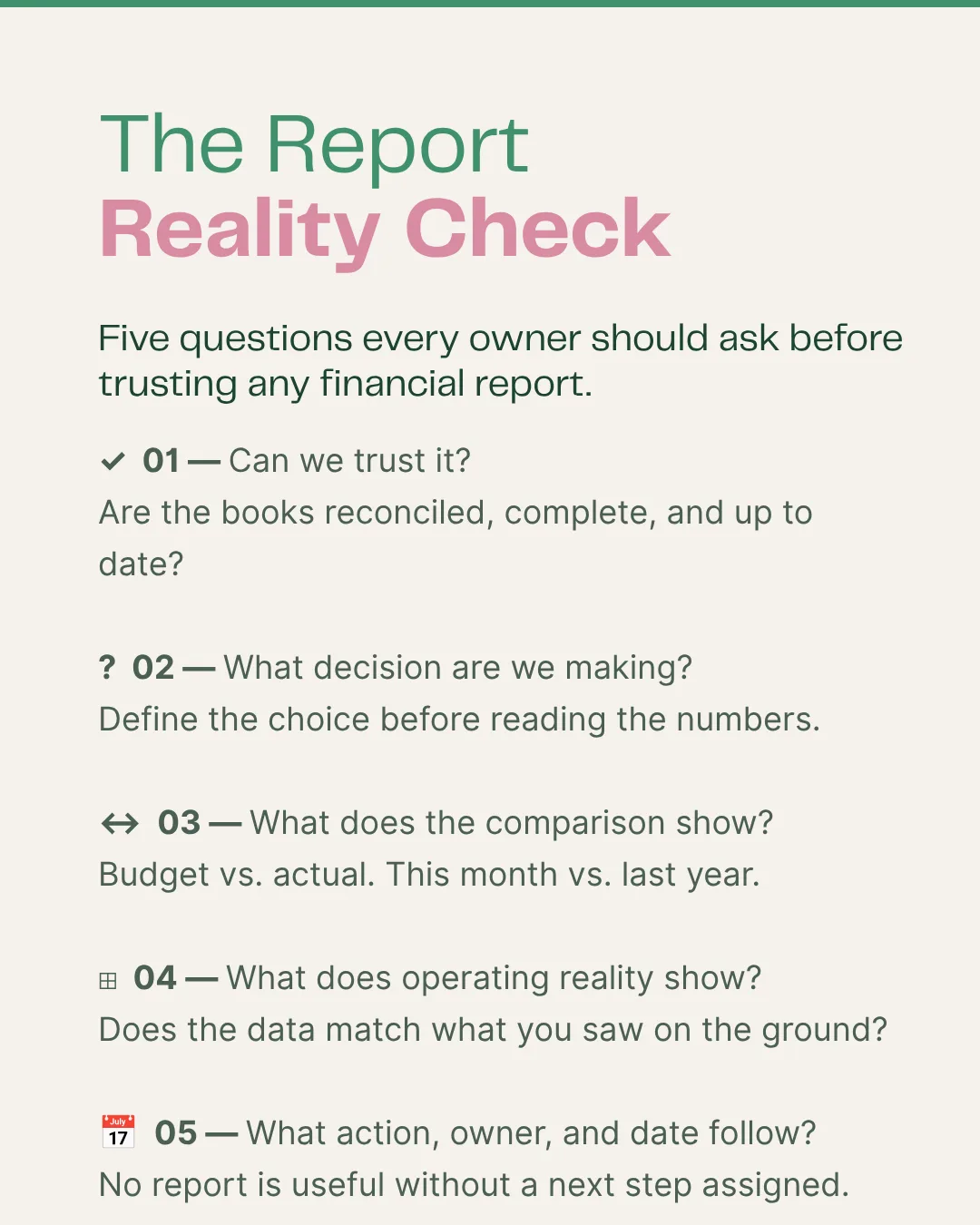
1. Can We Trust It?
Ask:
Are the relevant bank and credit-card accounts reconciled?
Is payroll fully recorded?
Are loan payments separated correctly between principal and interest?
Are transfers, owner transactions, and major purchases classified properly?
Is the report current enough for this decision?
Are the definitions consistent with prior periods?
The IRS’s recordkeeping guidance notes that good records support financial statements, tax reporting, and monitoring the business. Reliable source records are the foundation for all three.
If the inputs are unreliable, pause the analysis and fix them. A cleaner dashboard will not repair weak books.
2. What Question Are We Trying to Answer?
Start with the decision, not the report menu.
Examples include:
Can we hire another employee in the next 60 days?
Is our new service profitable after delivery labor?
Can we afford this equipment without weakening our cash reserve?
Why is revenue growing while cash is shrinking?
Which overdue invoices need attention this week?
Should we adjust pricing before renewing customer contracts?
The FASB’s conceptual guidance makes the principle clear: financial information is relevant when it can make a difference in a decision. If a metric cannot affect a decision, it may not deserve prime space on the owner’s dashboard.
3. What Does the Comparison Say?
Compare the result with the most meaningful reference point.
A seasonal business may need the same month last year. A company with an operating plan needs budget versus actual. A fast-changing business may need a rolling trend. A new initiative may need a unit-level target.
Do not react to one isolated month without checking whether the movement is normal, seasonal, planned, or caused by an unusual event.
4. What Does Operating Reality Say?
Now leave the accounting report for a moment.
Check the sales pipeline, production schedule, time records, customer conversations, inventory, project status, staffing, and upcoming commitments.
Imagine the financial report says revenue increased 14%.
Operating reality says discounts increased, overtime rose, and three large invoices remain unpaid.
The proper conclusion is not “Great month.”
It is: “Demand increased, but the new revenue may be producing weaker margin and slower cash. Investigate pricing, delivery labor, and collections before adding more volume.”
That is financial clarity.
5. What Action, Owner, and Date Follow?
End the review by completing one sentence:
Because ______ changed due to ______, we will ______ by ______, and ______ owns it.
For example:
Because gross margin fell from 57% to 51% after overtime and subcontractor costs increased, we will review pricing and staffing on the five lowest-margin projects by September 12, and Jordan owns the analysis.
That sentence is more useful than another page of charts.

Build an Owner View, Not a Data Warehouse
The owner’s summary should not replace the P&L, balance sheet, cash flow statement, reconciliations, or supporting schedules.
It should sit on top of them.
Think of it as a navigation layer: a short view that points you toward the decision and lets you drill into detail when something deserves investigation.
A practical owner view can include:
Liquidity: available cash and significant obligations due soon
Performance: revenue, margin, and operating-profit movement
Working capital: overdue receivables, payables, or inventory pressure
Plan: the few meaningful budget or forecast variances
Operating driver: one or two measures specific to the business model
Commentary: what changed, why, and what happens next
Decision log: action, owner, due date, and expected result
The exact metrics should vary by industry and business model. A project business may need backlog and job margin. A retailer may need inventory movement. A subscription business may need recurring revenue, churn, or failed payments.
For a tested starting point, see Everyday CPA’s five monthly financial metrics that matter.
[Graphic Placeholder: “One-Page Owner View” dashboard wireframe]
Reduce Report Clutter With a Simple Audit
Create a list of every recurring financial report, spreadsheet, and dashboard the business produces.
For each one, record:
Who uses it
Which decision it supports
Where the data comes from
How current it is
Whether its definitions match other reports
What happens when a number crosses a threshold
Then place it in one of four categories.
Keep
The report is trusted, timely, understood, and connected to a recurring decision.
Repair
The report supports a real decision, but its inputs, definitions, timing, or comparisons need work.
Combine
Two or more reports answer parts of the same question and can be summarized into one owner view.
Retire
Nobody uses the report, it duplicates other information, or it cannot change a decision.
Do not delete the detailed accounting records underneath the reporting system. The goal is fewer numbers in the owner’s immediate field of view, not fewer reliable records.
What a CPA Adds Beyond Generating Reports
Software can calculate. A report generator can summarize. AI can identify patterns and draft explanations.
But a business decision may require someone to determine whether the books are reliable, understand tax consequences, distinguish timing from performance, challenge an assumption, and connect the report with what the owner knows about the business.
That judgment becomes especially important when:
Profit and cash point in different directions
A major decision depends on unreconciled or incomplete records
Revenue is growing while margin falls
Receivables are aging
Debt, taxes, or payroll are becoming harder to cover
Different reports produce conflicting answers
Owner compensation or distributions affect the analysis
A hire, purchase, loan, price change, or expansion is under consideration
You do not need to become an accountant to run your business.
You need an accounting system that gives you information you can trust, plus enough interpretation to know what to do with it.
Stop Measuring the Volume of Data
Financial clarity is not measured by the number of reports in your inbox.
It is measured by whether you can explain:
What changed
Why it changed
What it means for cash, profit, risk, and taxes
What decision must be made
Who will act and when
Start with trustworthy records. Ask one business question. Compare the report with operating reality. Investigate the exception. Choose the next action.
Then close the other tabs.
If your reports keep creating questions instead of decisions, explore CPA-led financial clarity through iPacio or book a conversation with Kelly or Cat.
Important: This article provides general educational information, not personalized accounting, tax, legal, or financial advice. Appropriate reports, metrics, accounting treatments, and actions depend on your business, industry, accounting method, entity structure, and jurisdiction. Consult a qualified professional about your situation.

FAQ: Financial Reports and Business Reality
What financial reports should an owner review?
The three foundational statements are the income statement, balance sheet, and cash flow statement. Many owners also need receivables, payables, budget-versus-actual, and business-specific operating information. The right owner view should be concise while preserving detailed supporting records underneath it.
Why do financial reports sometimes disagree with the bank account?
Profit and cash measure different things. Receivables, payables, inventory, debt principal, equipment purchases, owner distributions, and timing differences can cause reported profit and bank cash to move in different directions. Everyday CPA’s guide explains why your P&L may not match financial reality.
How can I tell whether a dashboard is useful?
A useful dashboard relies on reconciled information, uses consistent definitions, shows meaningful comparisons, highlights exceptions, and supports specific decisions. Every material exception should lead to a question, action, owner, or follow-up date.
Does accounting software create financial clarity?
Accounting software can record, organize, and summarize data. It cannot independently supply every missing fact, verify each classification, understand the owner’s goals, or choose the right response. Financial clarity requires reliable data plus context and informed interpretation.