
Cat Glass, CPA
Why Your P&L Is Lying to You: How to Read a Profit and Loss Statement
Your profit and loss statement may not be lying on purpose.
But if you are using it as the only source of truth for your business, it can absolutely mislead you.
Maybe the bottom line says you made money, but the bank account feels thin. Maybe revenue is up, but payroll feels heavier every month. Maybe QuickBooks shows a clean report, but you still do not know whether you can hire, pay yourself, buy equipment, or survive a slow season.
That is the moment many business owners quietly wonder: “If I am profitable, where did the money go?”
The answer is usually not one big dramatic mistake. It is usually a stack of smaller issues: timing, categories, unpaid invoices, debt payments, owner draws, tax exposure, missing expenses, old bookkeeping problems, and reports that were never designed to answer the question you are really asking.
A profit and loss statement is useful. It matters. But it is not the whole story.
And when it is misunderstood, incomplete, or built on messy books, it can make a struggling business look fine or make a healthy business look worse than it is.
What a Profit and Loss Statement Actually Shows
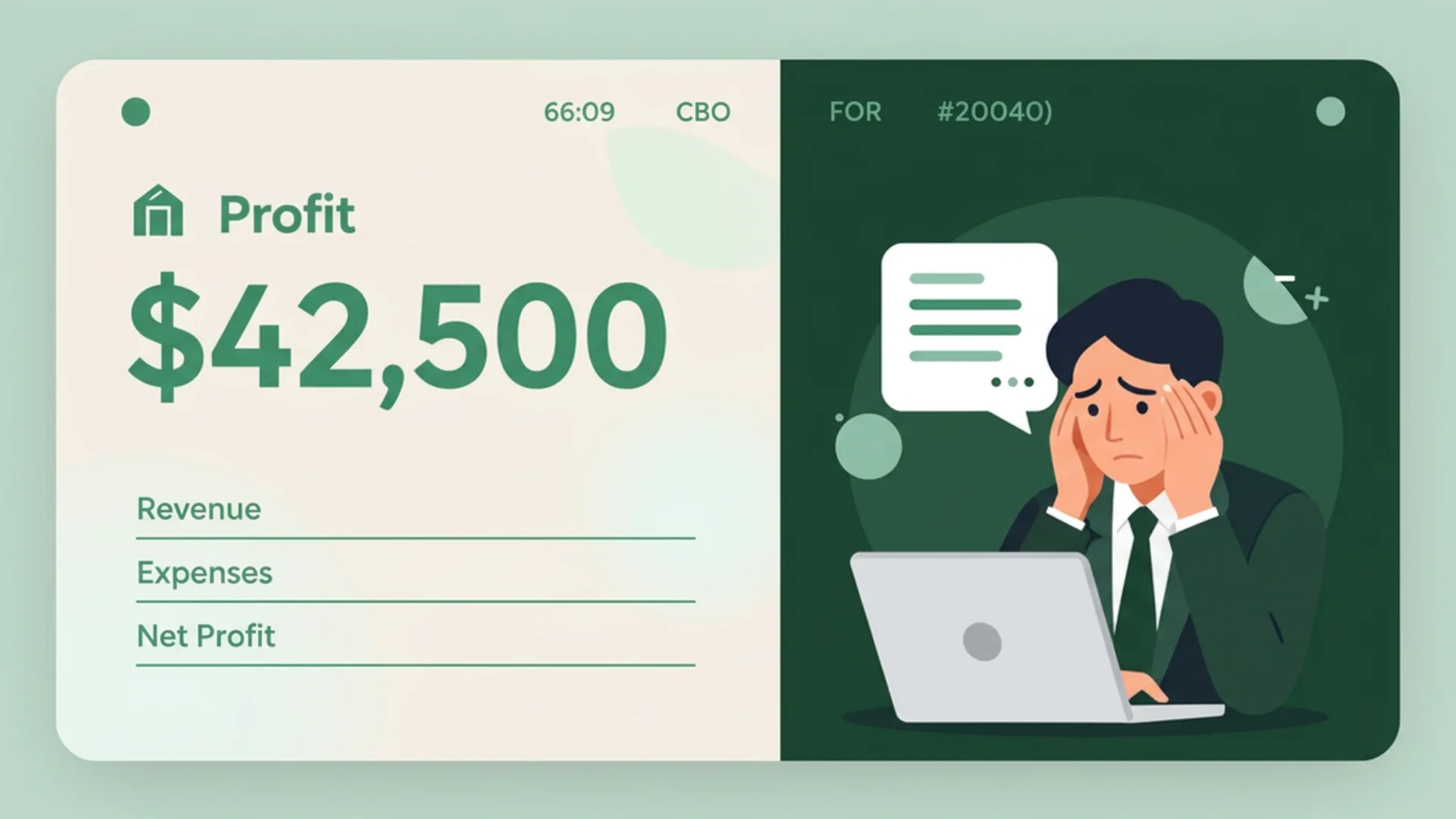
A profit and loss statement, also called a P&L or income statement, shows revenue, expenses, and net income or loss over a defined period.
The basic formula is simple:
Revenue - Expenses = Net Income or Loss
That matches the way the U.S. Small Business Administration defines a P&L: a report that measures net income or loss over a specific period of time. SBA glossary
So far, so good.
If you want to know whether your business brought in more than it spent during a month, quarter, or year, the P&L is one of the first reports to review.
But here is where business owners get into trouble: the P&L does not show everything that affects your financial reality.
It does not automatically show whether customers have paid you.
It does not show every debt payment in the way owners expect.
It does not explain whether owner draws were healthy or too aggressive.
It does not tell you whether you have enough cash for payroll next month.
It does not tell you whether your tax bill is building quietly in the background.
It does not tell you whether your QuickBooks categories are correct.
It is a report. It is not a financial advisor. It is not a cash flow plan. It is not a tax projection. It is not a business strategy.
That is why your P&L may be technically “right” and still not give you clarity.
Everyday CPA has said this before: a report may be technically correct and still not useful. Financial clarity happens when reports are translated into business meaning. EverydayCPA: Financial Clarity for Small Business Owners
Why Your P&L Can Mislead You
Your P&L is not usually wrong because the report itself is bad. It becomes misleading when the numbers underneath it are incomplete, misclassified, or viewed without context.
Here are the biggest ways that happens.
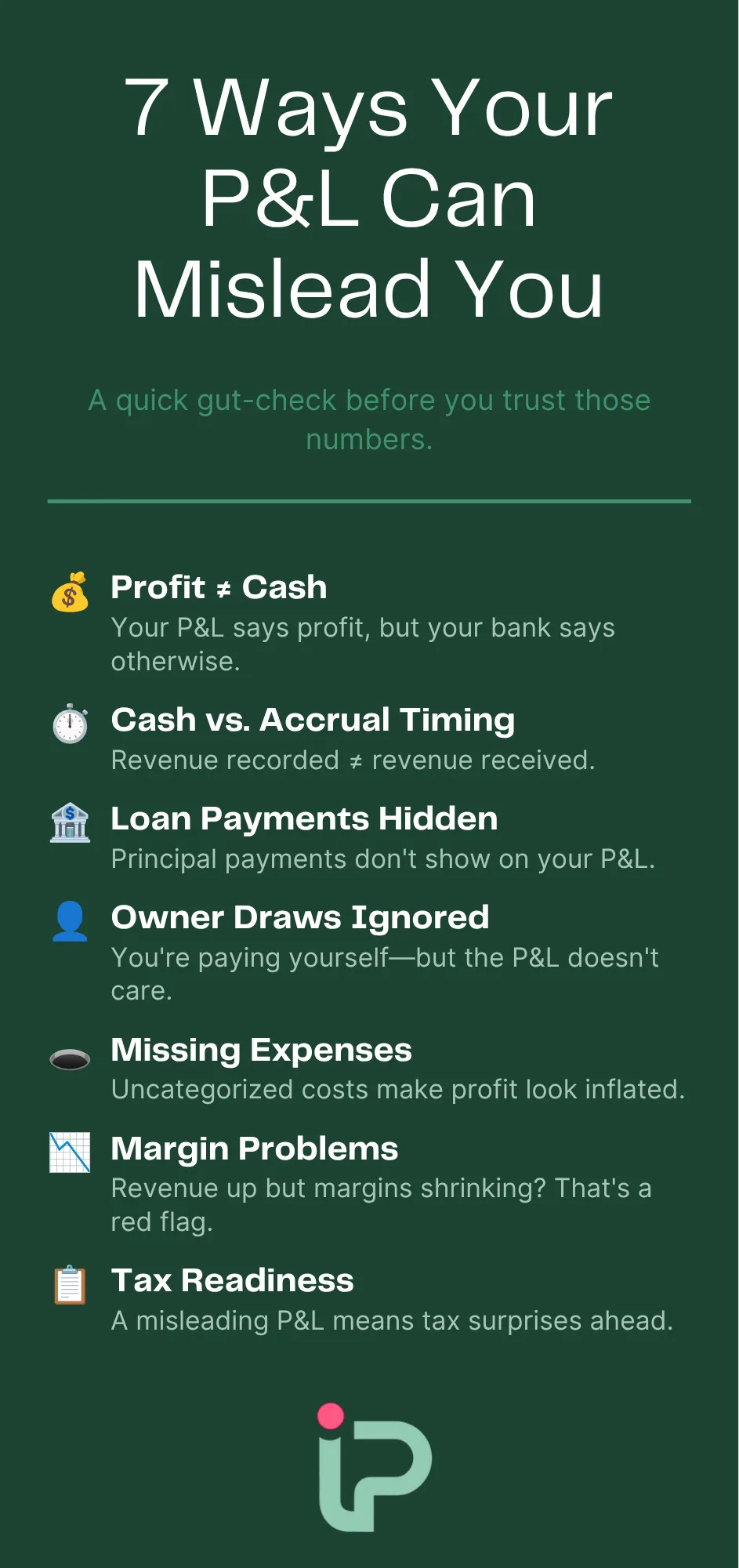
1. Profit Is Not Cash
This is the classic trap.
Your P&L may show profit, but profit does not mean cash is sitting in the bank.
A business can show $20,000 in profit and still feel broke if cash is tied up in unpaid invoices, inventory, loan payments, owner draws, taxes, or timing gaps.
Regions puts it plainly: profit is not the same thing as cash on hand. The income statement can show profitability, while cash flow tracks money coming in and going out. Regions financial statements guide
This matters because bills do not get paid with “net income” on a report.
Payroll needs cash.
Rent needs cash.
Taxes need cash.
Vendors need cash.
You can be profitable on paper and still be one late customer payment away from stress.
That does not mean the P&L is useless. It means it needs to be read alongside cash flow.
2. Cash vs. Accrual Timing Changes the Story
Your P&L may look different depending on whether it is run on a cash basis or accrual basis.
Under the cash method, income is generally reported when received and expenses are deducted when paid. Under the accrual method, income is generally reported when earned, and expenses are deducted when incurred. The IRS explains this distinction in Publication 538. IRS Publication 538
QuickBooks also distinguishes between cash and accrual reports. An accrual report can show income even if customers have not paid invoices, while a cash basis report generally shows income when payment has been received and expenses when they have been paid. QuickBooks support
That means your P&L may be telling a different story depending on the report setting.
If you are looking at accrual profit, you may see revenue that has been earned but not collected.
If you are looking at cash basis profit, you may miss obligations that have been incurred but not paid.
Neither view is automatically “bad.” But if you do not know which one you are looking at, you may make the wrong decision.
3. Loan Payments Do Not Show Up the Way Owners Expect
Many owners assume that if cash left the bank account, it should show up as an expense on the P&L.
That is not always how accounting works.
For example, the interest portion of a loan payment is typically an expense. But the principal portion reduces a liability on the balance sheet. It may drain cash without reducing profit on the P&L.
So the P&L may say you made money.
Your bank account may say: “Not after that debt payment.”
This is one reason business owners feel like the report is lying. The report is not necessarily wrong. It is answering a narrower question than the owner is asking.
The owner is asking: “Where did the cash go?”
The P&L is answering: “Did revenue exceed expenses under this accounting method during this period?”
Those are different questions.
4. Owner Draws and Distributions Can Hide the Real Picture
If you take money out of the business as an owner draw or distribution, that usually does not appear as a normal business expense on the P&L.
But it definitely affects the bank account.
This creates confusion.
The P&L might show profit.
The owner might say, “Great, I paid myself.”
Then tax time arrives, cash is low, and the business does not have enough set aside.
The issue is not that owners should never take money out. Owners should be paid. The issue is that owner pay needs to be understood in context: profit, cash flow, taxes, business reserves, debt, and future obligations.
A P&L alone will not manage that for you.
5. Missing or Misclassified Expenses Can Inflate Profit
A P&L is only as good as the bookkeeping behind it.
If expenses are missing, coded to the wrong category, duplicated, or sitting in uncategorized transactions, your report may show profit that is not real.
Common examples include:
Contractor payments coded inconsistently.
Personal expenses mixed with business expenses.
Loan payments treated incorrectly.
Transfers accidentally counted as income.
Credit card charges missing from the file.
Sales tax or payroll tax handled incorrectly.
Equipment purchases categorized as ordinary expenses when they may need different treatment.
Old transactions sitting in suspense, ask-my-accountant, or uncategorized expense accounts.
QuickBooks can generate a report. But someone still has to know whether the report is accurate. Everyday CPA makes this point directly in its article on why business owners should not have to become bookkeepers. Read the article
6. Revenue Growth Can Hide Margin Problems
More revenue feels good.
But revenue growth can make a business more stressful if expenses, payroll, inventory, debt, taxes, or complexity rise faster than profit.
Everyday CPA’s financial clarity article says growth without clarity can make the business more stressful, and that not all revenue is good revenue. EverydayCPA financial clarity article
This is one of the most dangerous P&L traps.
You see top-line growth and assume the business is improving.
But if gross margin is shrinking, labor is creeping up, advertising costs are rising, or delivery costs are eating every new dollar, the business may be getting bigger without getting healthier.
That is not growth.
That is busier confusion.
7. The P&L Does Not Show Tax Readiness
Your P&L may show income, but it does not automatically tell you whether your records are tax-ready.
A clean-looking report can still hide problems.
Are expenses properly supported?
Are owner draws and payroll handled correctly?
Are meals, travel, auto, contractors, and home office items classified properly?
Are estimated taxes being planned throughout the year?
Are balance sheet accounts reconciled?
Is the business using the right accounting method?
These questions matter because tax outcomes are not based on vibes. They are based on records, classifications, timing, and rules.
Your P&L might be a starting point for tax planning. It should not be mistaken for tax planning.
How to Read a P&L Without Being Fooled
You do not need to become an accountant to read your P&L better.
But you do need a better rhythm than glancing at the bottom line and moving on.
Here is a practical review process.
Start With the Date Range
Before you react to the report, check the period.
Are you looking at this month?
Year-to-date?
Last quarter?
A custom range?
Many bad decisions start with the wrong date range. A business that looks profitable year-to-date may have had a terrible current month. A seasonal business may look weak in the off-season but healthy over the full year.
The P&L only tells you what happened during the period selected.
Check Cash vs. Accrual
Next, check the accounting basis.
If the report is accrual, ask: “How much of this revenue has actually been collected?”
If the report is cash basis, ask: “What expenses or bills have we incurred but not paid yet?”
Neither setting gives the full story by itself. The point is to know what you are looking at before you act on it.
Look at Gross Profit Before Net Profit
Many owners jump straight to the bottom line.
Do not skip gross profit.
Gross profit shows what is left after the direct cost of delivering your product or service. If gross profit is weak, the business may have a pricing problem, cost problem, labor efficiency problem, production problem, or customer mix problem.
A business can have strong sales and weak gross profit.
That means the work is coming in, but the economics may not be working.
Compare Percentages, Not Just Dollars
Dollar amounts matter, but percentages often tell the truth faster.
If revenue increased 20%, but payroll increased 45%, something changed.
If sales are up, but gross margin is down, the new revenue may be less profitable.
If software subscriptions, subcontractors, or ad spend are rising faster than sales, the P&L may be warning you before cash gets tight.
Comparing each line item as a percentage of revenue makes patterns easier to see.
Compare This Period to Prior Periods
A single P&L is a snapshot.
A comparative P&L tells a story.
Compare this month to last month. Compare this quarter to last quarter. Compare this year-to-date period to the same period last year.
Look for weird movements.
Why did meals double?
Why did subscriptions creep up?
Why did revenue rise but profit fall?
Why did contractor costs spike?
Why did a usually stable expense disappear?
The goal is not to audit every penny every day. The goal is to notice what changed while there is still time to respond.
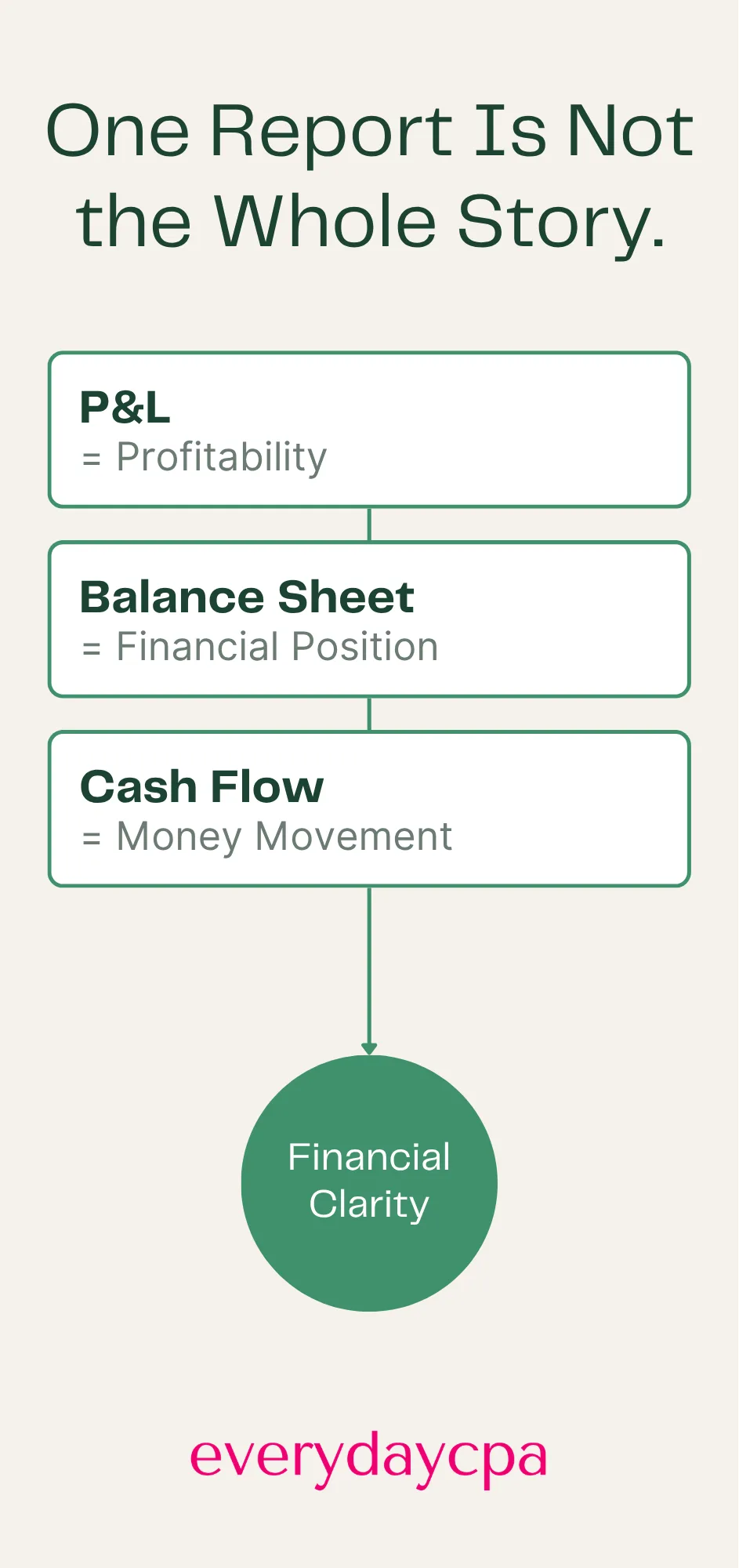
Tie the P&L to the Balance Sheet and Cash Flow
The P&L should never be reviewed alone.
At minimum, pair it with:
A balance sheet.
A cash flow view.
Accounts receivable.
Accounts payable.
Debt balances.
Tax estimates.
Owner pay/distribution history.
Regions notes that the core financial statements each provide a different perspective and work together to give a more complete picture. Regions guide
That is the heart of the issue.
Your P&L tells part of the truth.
The rest lives in the balance sheet, cash flow, tax planning, and business context.
How to Fix a P&L You Do Not Trust
If your P&L feels unreliable, do not panic.
A messy report does not mean you are irresponsible. It means the system needs attention.
Here is how to fix it.
1. Reconcile the Accounts
Start with the basics.
Bank accounts and credit cards should be reconciled regularly. If accounts are not reconciled, the P&L may be missing transactions, duplicating transactions, or including old errors.
This is not glamorous work.
But it is the foundation.
If the bank and credit card accounts are not clean, the report is not ready for serious decisions.
2. Clean Up Uncategorized Transactions
Uncategorized income and expenses are a warning sign.
They usually mean transactions entered the system, but nobody made a final decision about what they were.
That may be fine temporarily.
It is not fine as a long-term reporting habit.
Review uncategorized, suspense, and “ask my accountant” accounts every month. Those categories are holding areas, not permanent homes.
3. Review the Chart of Accounts
Your chart of accounts is the structure behind the P&L.
If it is too vague, the report will not answer useful questions.
If it is too detailed, the report becomes noise.
A good chart of accounts should match how the owner actually needs to understand the business. It should separate meaningful revenue streams, direct costs, payroll, overhead, owner-related items, taxes, and unusual expenses.
The goal is not a beautiful accounting file.
The goal is a report that helps you make better decisions.
4. Separate Business and Personal Activity
Mixed personal and business expenses make reports harder to trust.
They also create tax and documentation headaches.
If personal items are running through the business, they need to be identified and handled properly. If business expenses are paid from personal accounts, they need a consistent process too.
Clean boundaries create cleaner reports.
Cleaner reports create better decisions.
5. Track Cash Flow Separately
Do not ask the P&L to do a job it was not designed to do.
Use the P&L to understand profitability.
Use cash flow reporting to understand money movement.
Use the balance sheet to understand assets, liabilities, and equity.
Use tax planning to understand what may be owed.
When owners rely only on the P&L, they miss obligations that affect cash. When they rely only on the bank balance, they miss profitability. When they rely only on tax returns, they get information too late.
Financial clarity comes from using the right reports together.
6. Build a Monthly Review Rhythm
Your P&L is most useful when you review it consistently.
A monthly financial review should answer:
Did revenue change?
Did gross margin change?
Did fixed costs change?
Did owner pay/distributions make sense?
Did cash increase or decrease?
Are taxes being set aside?
Are receivables getting older?
Are payables building up?
What decision should change this month?
That last question matters most.
The point of financial reports is not to admire the numbers. The point is to use them.
7. Get CPA Review Before Big Decisions
If you are using your P&L to make decisions about hiring, expansion, taxes, owner pay, debt, entity structure, or selling the business, get professional review.
A CPA can help identify whether the numbers are accurate, whether the report is being interpreted correctly, and whether tax issues are hiding behind ordinary-looking line items.
This is especially important if your books have not been reviewed in months, if you are behind on reconciliations, or if QuickBooks has become a place where transactions go to be guessed at.
Everyday CPA’s approach is built around helping business owners move from confusing reports to useful financial clarity. You can book a call with Kelly or Cat or start with the free Tax Tips & Hacks book, which includes guidance for owners who use QuickBooks but do not trust the numbers.
The P&L Is Not the Enemy
Your P&L is not useless.
It is one of the most important reports in your business.
But it should not be treated like the whole truth.
A P&L can tell you whether revenue exceeded expenses during a period. It can help you spot margin problems, cost creep, and profitability trends. It can support tax planning, pricing decisions, and performance reviews.
But it cannot replace clean bookkeeping.
It cannot replace cash flow visibility.
It cannot replace tax planning.
It cannot replace owner context.
It cannot replace professional judgment.
The fix is not to ignore the P&L.
The fix is to read it better, clean up the data behind it, and connect it to the decisions you actually need to make.
Because business owners do not need more accounting homework.
They need numbers they can trust.
They need reports that explain what happened.
They need a system that turns financial activity into better decisions.
That is financial clarity.
And once you have it, the P&L stops feeling like a liar and starts becoming what it was supposed to be all along: a useful tool for running the business.
Important note: This article is general educational content, not personalized accounting, tax, legal, or financial advice. Your accounting method, tax treatment, entity structure, and reporting setup should be reviewed with a qualified professional who understands your specific business.