
Cat Glass, CPA
Business Bank Balance vs. Cash Flow: Stop Guessing

A customer pays a large invoice.
You open your banking app and see $82,000.
For a moment, everything feels possible. You could hire. Replace equipment. Increase your owner draw. Pay down debt. Finally approve that marketing project.
Then payroll clears. The credit card payment hits. A tax deadline arrives. Two customers pay late.
Suddenly, the business that appeared to have $82,000 is short on cash.
The bank did not make a mistake. The balance was accurate.
The mistake was treating that balance as an answer to a question it could not answer.
Your business bank balance tells you how much cash is sitting in an account at one moment. It does not tell you how much of that cash is already spoken for, what will leave next week, whether expected payments will arrive, or how much the business can safely commit.
When you make decisions from the balance alone, you are betting that the timing will work out.
That is why checking your bank account can feel like Russian roulette.
Your Business Bank Balance Is a Snapshot, Not a Forecast
A bank balance is useful. Every business owner should know how much cash the business has.
But a snapshot has limits.
It shows money that has reached the account, minus transactions the bank has processed. It does not provide a complete view of:
Bills due next week
Payroll and related taxes
Credit-card charges not yet paid
Checks or transfers that have not cleared
Estimated income-tax payments
Customer deposits committed to future work
Debt payments
Owner draws
Equipment purchases
Invoices customers may pay late
Seasonal drops in revenue
The bank app answers, “How much is here right now?”
Most business decisions require a different answer: “How much will still be available after the business meets its obligations?”
Those are not the same number.
The distinction is similar to the difference among the primary financial statements. A balance sheet shows what a business owns and owes at a point in time. An income statement measures financial performance over a period. A cash-flow statement shows cash moving through operating, investing, and financing activities. The SEC’s financial-statement guide explains why each view answers a different question.
Your bank account gives you one piece of that picture. It does not give you the whole picture.
Six Things Your Bank Balance Does Not Warn You About
1. Cash That Is Already Committed
Some of the money in your account already has a job.
It may need to cover payroll on Friday, a software renewal next week, rent on the first, or a subcontractor who completed work for a client.
Until those payments clear, the bank includes the money in your balance. Operationally, however, it may no longer be available.
This is how owners accidentally spend the same dollar twice: once in their head when approving an upcoming obligation, and again when the banking app still shows it as cash.
2. Taxes That Have Not Left Yet
A strong month can create both cash and a future tax obligation.
Depending on the business structure and the owner’s circumstances, that obligation may include estimated income taxes, self-employment tax, payroll taxes, state taxes, or sales taxes. The exact treatment varies, so tax reserves should be based on advice specific to the business.
The timing matters. The IRS describes federal income taxes as a pay-as-you-go system and notes that many people in business for themselves generally need to make estimated payments during the year. Paying too little or paying late can result in penalties. See the current IRS estimated-tax guidance.
Money intended for taxes may still appear in the operating account. That does not make it discretionary cash.
3. Credit-Card Spending That Has Not Hit the Bank
Your team may have already spent thousands on materials, travel, advertising, or software.
If those charges are sitting on a business credit card, the checking-account balance will not fall until you pay the card. Looking only at checking can make the business appear more liquid than it is.
This is one reason clean, current books matter. Bank accounts, credit cards, loans, and payment platforms have to be considered together.
4. Borrowed Money That Looks Like Revenue
A loan deposit increases your bank balance.
So does an owner contribution.
Neither automatically means the business earned money from operations. The cash arrived, but it came with a liability or an investment by the owner.
The SEC separates borrowing and debt repayment into financing activities because they are different from cash generated by normal operations. A business can therefore have a growing bank balance while its underlying operations are losing money.
The reverse can happen too. Paying down loan principal reduces cash even though the full payment is not necessarily an expense on the profit and loss statement.
A bank balance shows the result. It does not explain the source.
5. Revenue That Has Not Become Cash
You may have completed the work and issued the invoice. Your profit and loss statement may even recognize the revenue.
But payroll cannot be funded with an unpaid invoice.
If customers routinely take 45 or 60 days to pay, a profitable month can still produce a cash shortage. This is why accounts-receivable aging belongs in a cash review: it helps show who owes money, how long it has been outstanding, and which expected receipts are becoming less dependable.
For a fuller explanation of the difference between accounting profit and spendable cash, read Why Your P&L Is Lying to You.
6. What Happens Next
This is the largest gap.
Your banking app is mostly historical. It shows transactions that have already reached the bank.
A decision is forward-looking.
Hiring someone, signing a lease, buying equipment, increasing pay, or starting a large project creates future cash needs. Your current balance cannot tell you whether revenue will support those needs six weeks from now.
That requires a forecast.
The SBA recommends maintaining appropriate bookkeeping and using financial information to support cash-flow projections. It also emphasizes comparing actual results with forecasts instead of treating a forecast as a document that is created once and forgotten. See the SBA’s guidance on managing business finances and using financial forecasts.

The $82,000 Illusion
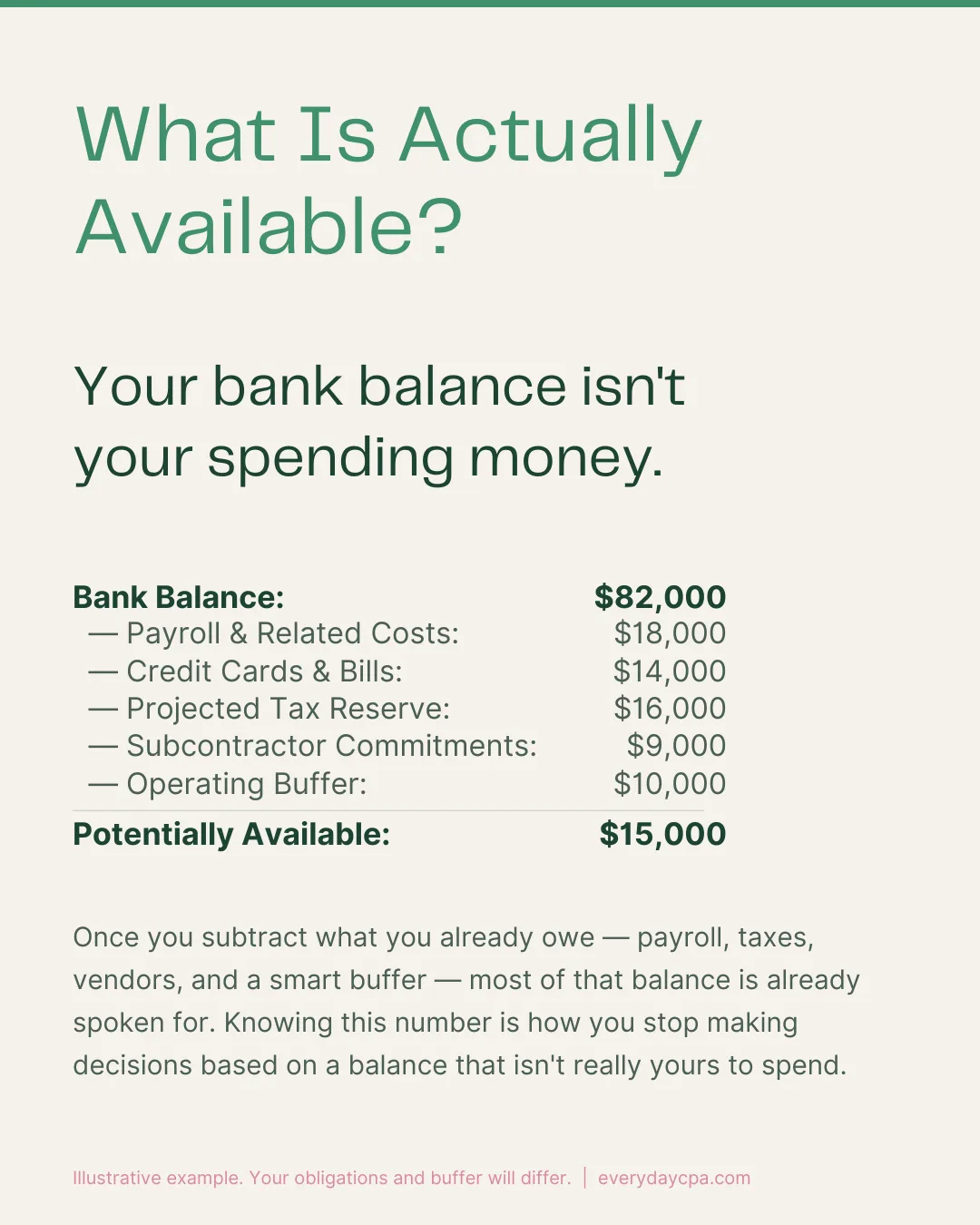
Suppose your operating account shows $82,000.
That feels like a healthy amount of cash. But before making a decision, you identify:
$18,000 for payroll and related costs
$14,000 for credit cards and vendor bills
$16,000 reserved for projected taxes
$9,000 for subcontractors completing prepaid client work
$10,000 as the business’s minimum operating buffer
That leaves $15,000 potentially available for a discretionary decision.
The $82,000 balance was not false. It was incomplete.
Now suppose you expect another $28,000 from customer invoices within two weeks. That forecast may improve the picture, but only if those customers pay when expected. If payment history suggests that one or two invoices will be late, treating the full $28,000 as guaranteed would create another misleading number.
Good cash management does not require perfect predictions. It requires making uncertainty visible before you spend.
Calculate Available Cash Before You Make a Decision
“Available cash” is a practical management view, not a separate line item required under generally accepted accounting principles.
A simple version looks like this:
Cleared bank cash − Payments issued or scheduled but not cleared − Cash restricted or earmarked for a specific purpose − Bills, payroll, taxes, and debt due within the decision period − The business’s minimum operating buffer = Cash potentially available for a discretionary decision
The decision period matters.
If you are approving a small, cancellable purchase, you may look a few weeks ahead. If you are hiring an employee or signing a long lease, you need a much longer view because the commitment continues after the current bank balance is gone.
The minimum operating buffer should also reflect the actual business. A company with predictable subscriptions and recurring revenue has different needs from a contractor with seasonal work, large material purchases, and slow-paying customers.
There is no responsible universal number that fits every business.
Your buffer should account for factors such as:
Essential weekly or monthly expenses
Revenue volatility
Customer concentration
Typical collection delays
Seasonality
Debt requirements
Access to credit
The consequences of a cash shortage
This is where CPA guidance can be valuable. The goal is not to maximize idle cash. It is to protect the business without unnecessarily freezing money that could support useful growth.
Replace Balance-Checking With a 20-Minute Weekly Cash Review
You do not need a hundred-tab spreadsheet or a finance degree.
Start with one short weekly process.
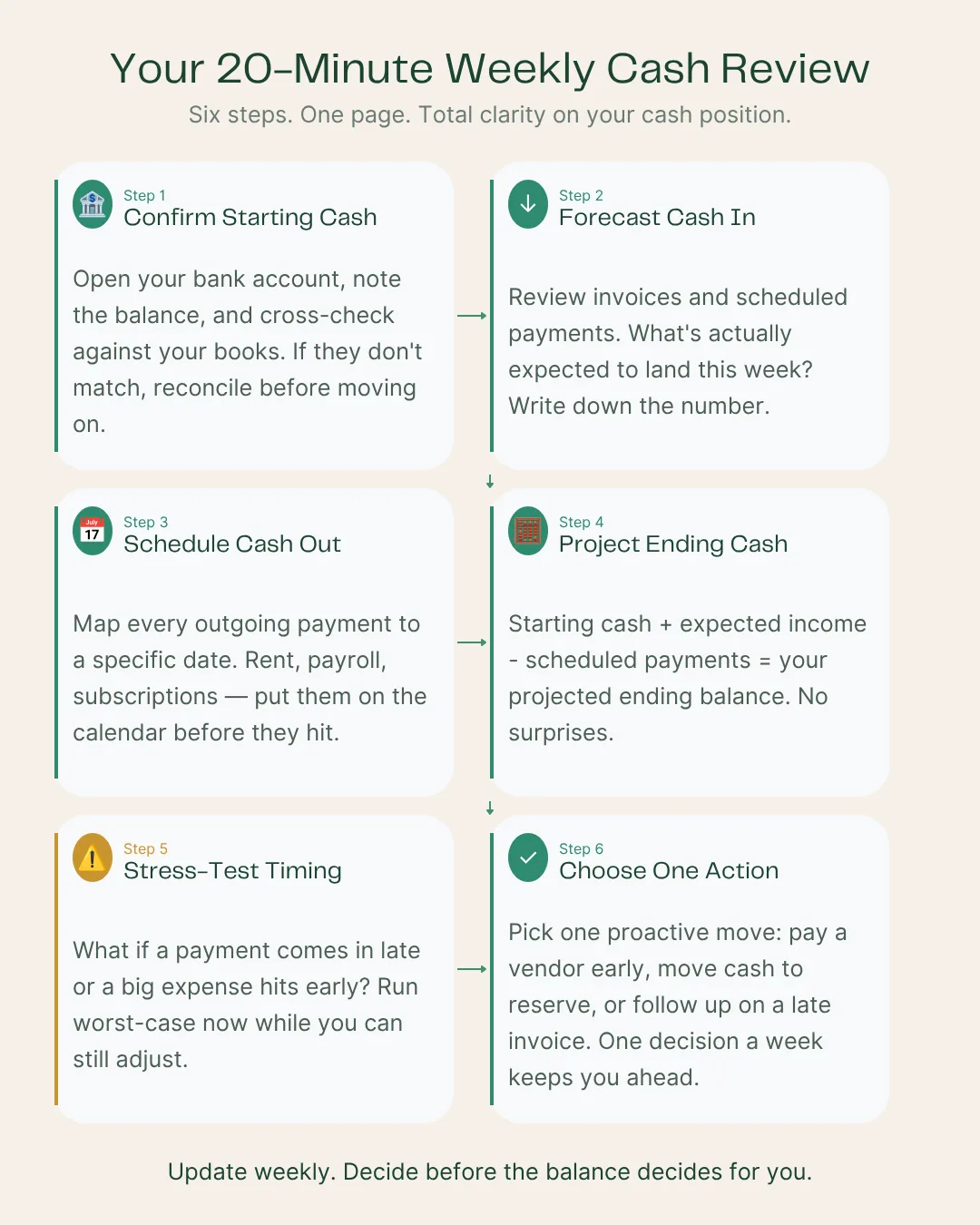
Step 1: Confirm the Starting Cash
Use the cleared balance, then account for checks, transfers, or payments that have been issued but have not reached the bank.
If the books are not reconciled, investigate large differences before relying on the number.
Step 2: List Expected Cash Inflows
List customer payments and other cash receipts by the week you realistically expect to receive them.
Do not automatically use an invoice’s due date. Use the customer’s payment behavior. A customer who normally pays 20 days late should not be forecast as an on-time payment merely because the invoice says “net 30.”
Separate highly dependable receipts from uncertain ones.
Step 3: List Cash Outflows by Due Date
Include payroll, rent, loan payments, credit cards, vendors, subscriptions, insurance, taxes, owner pay, and planned purchases.
Annual and quarterly obligations deserve special attention because they disappear from the monthly routine and then arrive all at once.
Step 4: Project the Weekly Ending Balance
For each week:
Starting cash + expected cash in − expected cash out = projected ending cash
Carry that ending balance into the next week.
A rolling forecast of roughly 8 to 13 weeks is often useful for near-term decisions because it is long enough to reveal payroll cycles, monthly bills, tax dates, and collection delays while remaining concrete enough to update. The appropriate horizon should still match the business and the decision.
Step 5: Run a Simple Stress Test
Ask two questions:
What happens if a major customer pays two weeks late?
What happens if an expected expense is 10% to 20% higher?
The goal is not to imagine every disaster. It is to see whether one ordinary surprise could push the business below its operating floor.
Step 6: Choose One Action
A cash review should lead to a decision.
That decision might be to:
Follow up on overdue invoices
Delay a discretionary purchase
Move tax reserves into a separate account
Negotiate a vendor payment date
Adjust an owner draw
Arrange credit before it is urgently needed
Proceed with an investment because the forecast supports it
Then update the forecast next week.
Do Not Replace One Misleading Number With Another
A forecast is not a promise.
It is a living estimate based on what you know today. Its value comes from updating it as customers pay, expenses change, and decisions are made.
It should also be reviewed alongside the business’s other financial information:
The profit and loss statement shows whether the business model is producing profit.
The balance sheet shows assets, liabilities, and equity at a point in time.
The cash-flow statement explains how cash changed.
Accounts-receivable aging shows collection risk.
Accounts-payable information shows what the business owes.
A forward-looking cash forecast shows where cash may become tight.
Together, these views provide context that a banking app cannot.
That is the heart of financial clarity: turning accurate, current financial information into an answer the owner can use.
Signs You Are Running the Business From the Bank Balance
The habit deserves attention if:
A large deposit immediately changes how much you feel able to spend.
Tax payments repeatedly feel like emergencies.
Payroll is comfortable one week and stressful the next.
You cannot explain why cash fell during a profitable month.
You decide on owner draws based on the current balance.
Credit-card balances surprise you.
Late customer payments create immediate pressure.
You avoid large decisions because you do not trust the numbers.
You check the bank account several times a day but still feel uncertain.
None of those signs means you are bad with money.
They mean the business needs a clearer financial system.
The Bank Account Should Be One Signal, Not the Whole Dashboard
Checking your business bank balance is not the problem.
Stopping there is.
The balance tells you where cash is now. Clean books help explain how it got there. A cash-flow forecast helps show where it may go next. CPA review adds tax awareness, accounting judgment, and the context behind the numbers.
That combination turns “I think we can afford it” into a decision you can defend.
Everyday CPA and iPacio are built around that idea: owners should receive clear, timely financial insight without becoming part-time bookkeepers.
When you are ready to replace balance-checking with financial clarity, book a conversation with Kelly or Cat.

Frequently Asked Questions
Is the money in my business bank account available to spend?
Not necessarily. Some cash may already be committed to payroll, bills, taxes, debt, customer work, or other upcoming obligations. Calculate available cash and review the forecast before making a significant commitment.
What is the difference between a bank balance and business cash flow?
A bank balance shows cash in an account at a particular moment. Business cash flow describes money moving into and out of the business over time. A forecast extends that view into expected future periods.
How often should I review business cash flow?
A weekly near-term cash review works well for many owner-operated businesses, with a more complete financial review monthly. Businesses with tight cash, volatile sales, or major projects may need more frequent monitoring.
Can accounting software calculate my available cash automatically?
Software can collect transactions, display balances, and help project recurring activity. It may not know whether a customer will pay late, whether money is reserved for taxes, or which future expense is optional. Automation becomes more useful when paired with accurate records, owner context, and professional review.
This article provides general educational information and is not personalized accounting, tax, legal, or financial advice. Cash reserves, tax obligations, and forecasting methods should be evaluated with a qualified professional who understands your business.