
Kelly Coughlin, CPA
Clean-Looking Books Are Not Always Tax-Ready Books
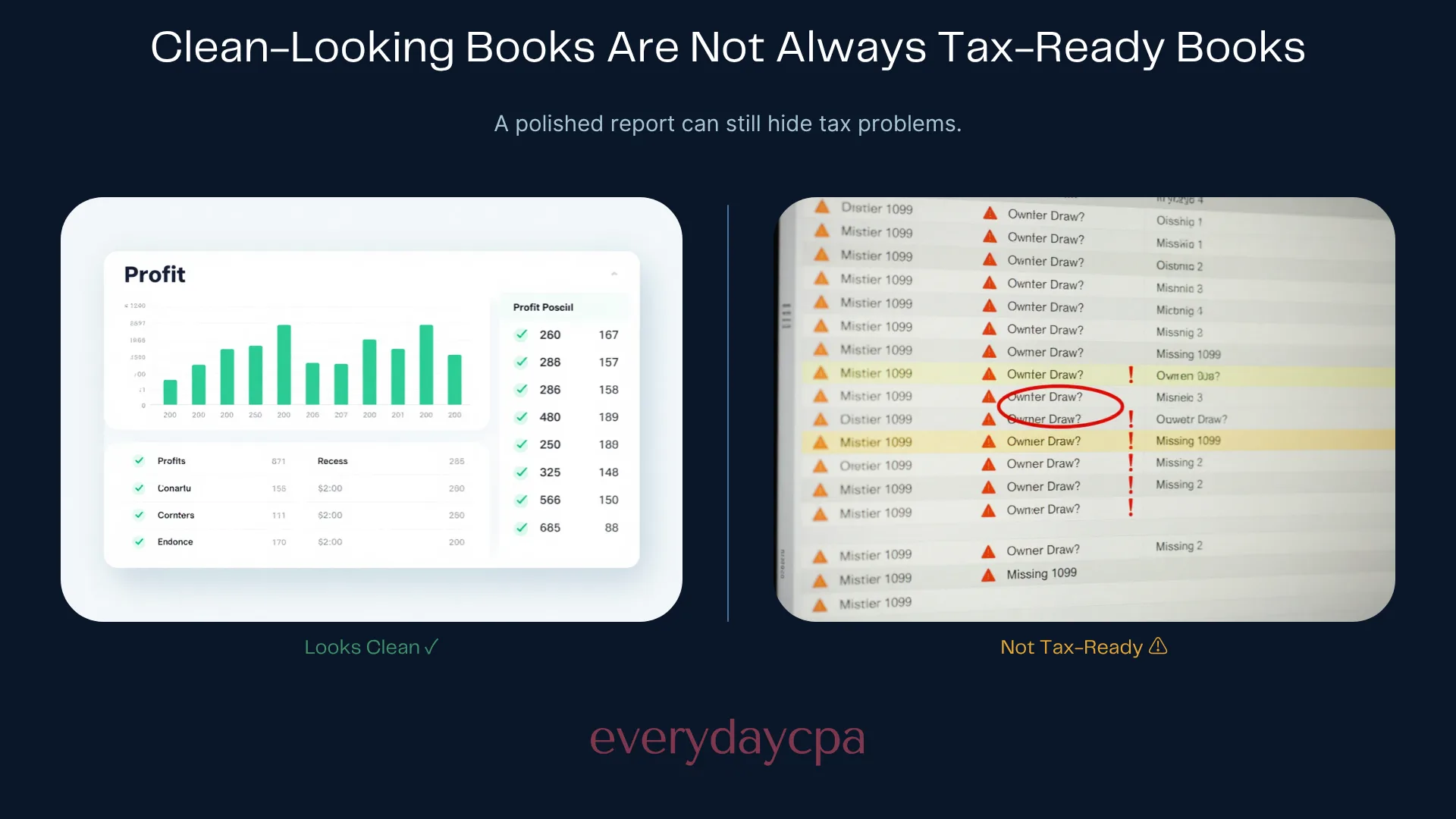
A profit and loss report can look clean and still be wrong.
That is one of the biggest risks with AI-generated financial information.
AI may organize transactions quickly. It may produce a polished report. It may create a dashboard that looks useful. It may summarize income, expenses, cash flow, and spending categories in a way that feels clear.
But clean-looking books are not the same thing as tax-ready books.
A report can look organized and still mislead the business owner.
Deposits can be misclassified.
Transfers can look like income.
Personal expenses can be mixed with business expenses.
Owner draws can be treated incorrectly.
Contractor payments may need review.
Expenses may be missing documentation.
Credit card charges may be categorized incorrectly.
Loan payments may be recorded wrong.
Bank feeds may miss the real business purpose of a transaction.
These mistakes matter.
They can affect tax returns, cash flow decisions, profit analysis, payroll tax, sales tax, estimated taxes, lending, pricing, owner compensation, and business planning.
That is why AI alone is not adequate.
AI can compile information quickly. But subject matter experts must train the system, review the results, and apply judgment.
Fast books are not enough.
Business owners need accurate, useful, tax-aware financial information.
They need financial clarity.
A clean-looking report is not always a tax-ready report. If your books look organized but still feel uncertain, let’s review what is really going on.

Table of Contents
What “Clean-Looking Books” Means
What “Tax-Ready Books” Really Means
Why a Clean Profit and Loss Report Can Still Be Wrong
The Risk of AI-Generated Reports
Common Problems Hidden Inside Clean-Looking Books
Clean Books vs. Tax-Ready Books: The Real Difference
Why Tax-Ready Books Require CPA Review
Why Business Owner Context Still Matters
Why Fast Reports Can Create False Confidence
How to Know Whether Your Books Are Tax-Ready
The Better Model: AI-Assisted Compilation + CPA Review + Owner Confirmation
Where iPacio Fits
What Business Owners Should Do Next
FAQ
What “Clean-Looking Books” Means
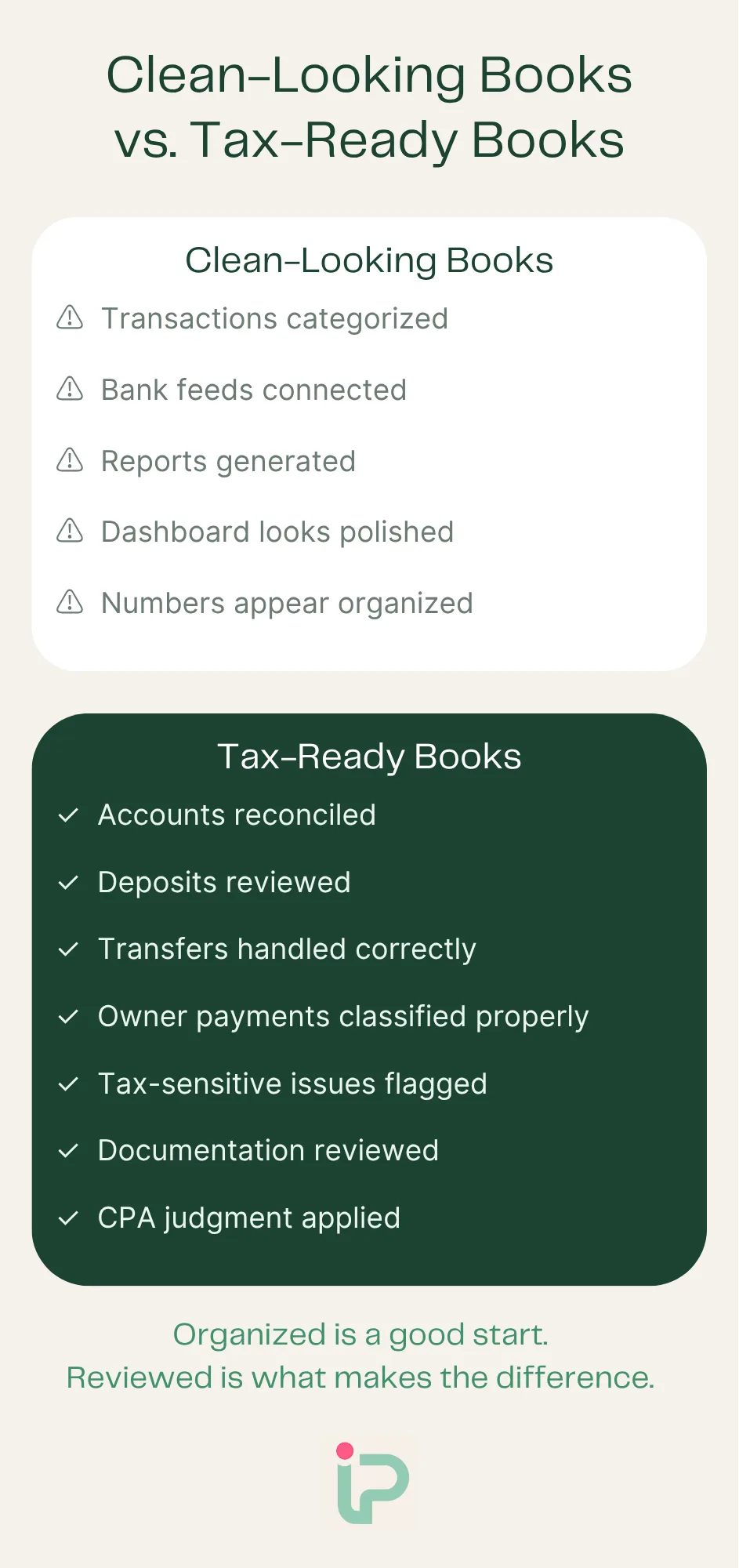
Clean-looking books are books that appear organized on the surface.
The transactions may be categorized. The bank feeds may be connected. The profit and loss report may have normal-looking income and expense categories. The dashboard may show charts and summaries. The books may look better than a pile of receipts, spreadsheets, or bank statements.
That is a good start.
But it is only a start.
Clean-looking books may answer the question:
“Does this look organized?”
Tax-ready books must answer a different question:
“Can this financial information be relied on for tax filing, tax planning, and business decisions?”
Those are not the same thing.
A business owner can have clean-looking books and still have serious tax or accounting problems hiding underneath.
That is especially true when the books were generated quickly by software, automation, bank rules, or AI without proper review.
A polished report can create confidence.
But confidence is only useful when the information is correct.
What “Tax-Ready Books” Really Means
Tax-ready books are not just categorized transactions.
Tax-ready books are financial records that are organized, complete, reconciled, reviewed, and prepared in a way that supports tax return preparation and tax planning.
That means the books should be more than neat.
They should be reliable.
Tax-ready books should help answer questions like:
Are all business bank accounts included?
Are all business credit cards included?
Are bank and credit card accounts reconciled?
Are deposits properly classified?
Are transfers excluded from income and expenses?
Are owner draws and contributions treated correctly?
Are personal expenses separated from business expenses?
Are loan payments split correctly between principal and interest?
Are contractor payments identified for possible 1099 reporting?
Are large purchases reviewed for capitalization or depreciation?
Are payroll-related items recorded properly?
Are sales tax or payroll tax liabilities handled correctly?
Are expenses supported by reasonable documentation?
Do the financial statements make business sense?
Are there tax-sensitive issues that should be discussed before filing?
That is a much higher standard than simply having a clean-looking report.
Tax-ready books require organization, accuracy, judgment, and context.
Why a Clean Profit and Loss Report Can Still Be Wrong
A profit and loss report can look professional and still be misleading.
That is because a profit and loss report only shows what has been recorded and categorized inside the system.
If the underlying information is wrong, the report will be wrong.
The problem is that the report may not announce that it is wrong.
It may look perfectly normal.
It may show revenue, expenses, and net income. It may include categories that look reasonable. It may show a profit number that seems precise.
But precision is not the same as accuracy.
For example, a profit and loss report may show $250,000 of revenue.
But what if $30,000 of that “revenue” was actually transfers from another account?
What if a $20,000 loan deposit was classified as income?
What if customer payments were duplicated?
What if some merchant deposits were recorded as gross revenue but fees were missing?
What if owner contributions were treated as sales?
The report may look clean.
But the income number may be wrong.
The same problem can happen with expenses.
Expenses may look neatly categorized, but some may be personal, duplicated, capitalized incorrectly, missing documentation, or recorded in the wrong period.
A profit and loss report is only useful if the underlying books have been reviewed.
The Risk of AI-Generated Reports
AI-generated reports can be helpful.
They can also be risky.
AI can read transaction data quickly. It can identify patterns. It can suggest categories. It can organize financial information. It can summarize activity in plain English.
Those are useful capabilities.
But AI-generated financial information creates a specific risk:
It can look finished before it has been reviewed.
A traditional bookkeeping mess is obvious. A stack of receipts looks messy. An incomplete spreadsheet looks incomplete. A bank statement folder with missing months feels unfinished.
But an AI-generated dashboard may look polished.
That polish can hide uncertainty.
AI may create categories, charts, summaries, and explanations that feel authoritative. But if the system does not understand business purpose, tax treatment, owner intent, entity structure, documentation, and accounting logic, the report may still be wrong.
AI can speed up compilation.
It should not be treated as the final authority.
Fast books are not automatically tax-ready books.
To understand this distinction further, read AI Can Guess. But a Guess Is Not Financial Clarity.
Common Problems Hidden Inside Clean-Looking Books
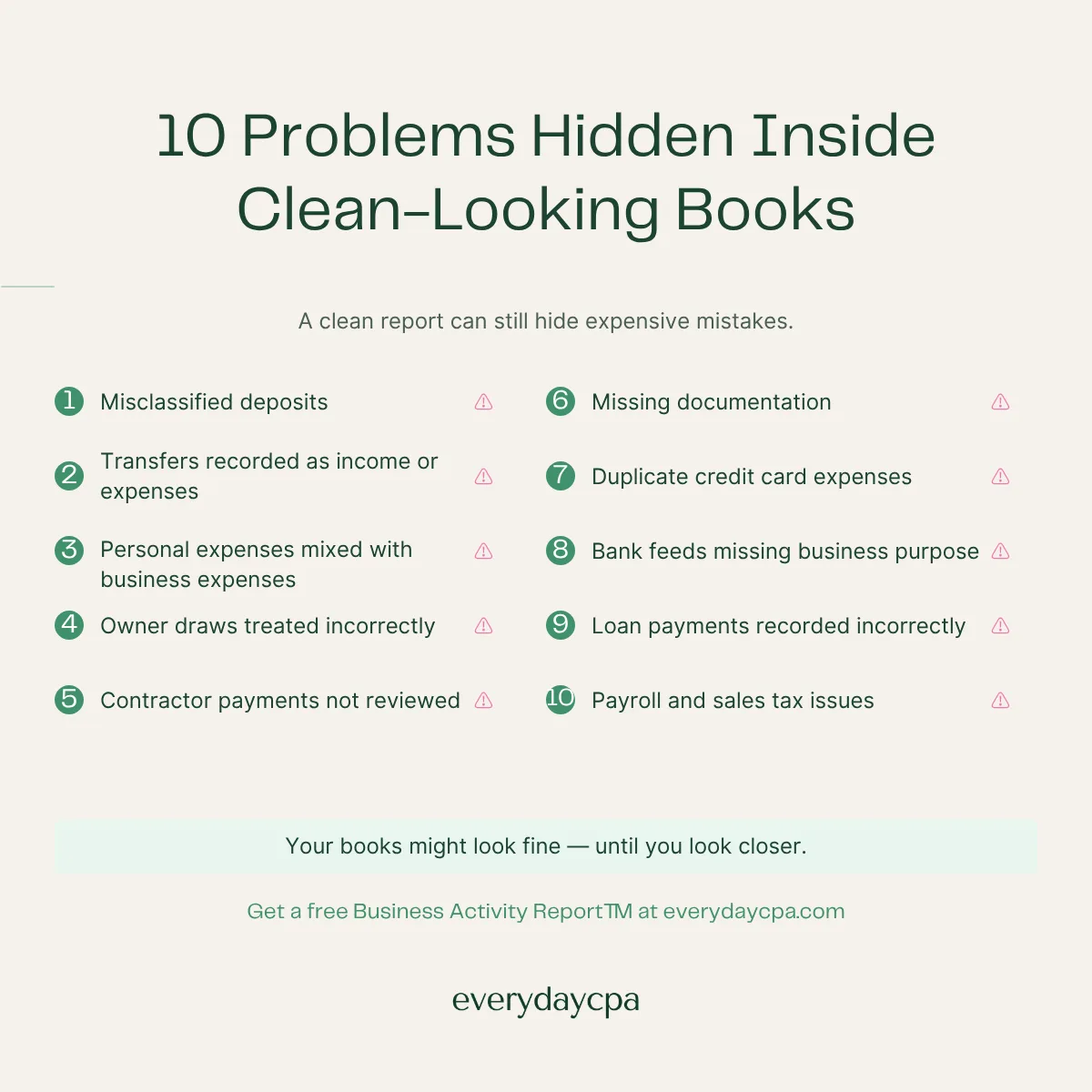
Clean-looking books can hide several problems that matter for tax and business decisions.
Here are the most common issues business owners should understand.
1. Deposits Can Be Misclassified
Not every deposit is revenue.
A deposit may be customer income, but it may also be a loan, owner contribution, transfer, reimbursement, refund, insurance proceeds, tax refund, returned payment, or capital contribution.
If deposits are automatically treated as revenue, taxable income may be overstated.
If true revenue is treated as a transfer or excluded, income may be understated.
Both create problems.
Example
The owner transfers $25,000 from personal savings into the business account to cover payroll during a slow month.
The bank feed shows a deposit.
AI or software may classify it as income.
The profit and loss report now shows more revenue than the business actually earned.
That report may look clean.
But it is not tax-ready.
2. Transfers Can Look Like Income or Expenses
Transfers are one of the most common sources of messy books.
Money moves between checking, savings, credit cards, payment processors, loan accounts, and owner accounts. If those transfers are not matched correctly, they may appear as income or expenses.
That can distort both profit and cash flow.
Example
The owner moves $10,000 from business checking to business savings. If one side of the transfer is recorded as income, revenue is overstated. If the other side is recorded as an expense, expenses are overstated too.
The books may have activity.
The reports may have categories.
But the financial information is wrong.
Tax-ready books require transfers to be reviewed and handled properly.
3. Personal Expenses Can Be Mixed With Business Expenses
Many business owners accidentally mix personal and business activity.
A business card gets used for a personal purchase. A personal card gets used for a business expense. A reimbursement is forgotten. A family expense runs through the business account by mistake.
This is common.
But it matters.
Personal expenses should not simply be treated as deductible business expenses.
Example
A business credit card includes software subscriptions, client meals, gas, office supplies, groceries, family travel, and personal purchases.
If everything is categorized as business expense, the profit and loss report may show lower profit than reality.
The tax return may include deductions that need review.
Clean-looking categories do not make personal expenses deductible.
Tax-ready books require separation and judgment.
4. Owner Draws Can Be Treated Incorrectly
Owner payments are often misunderstood.
The correct treatment depends on the business structure.
A sole proprietor, single-member LLC, partnership, S corporation, and C corporation may handle owner compensation differently.
Owner draws, distributions, wages, reimbursements, guaranteed payments, loans, and capital contributions are not the same thing.
AI or bookkeeping software may not know the correct treatment without context.
Example
An S corporation owner takes regular payments from the business account. Some are payroll. Some are reimbursements. Some are distributions.
If all payments are categorized as expenses, the books may be wrong.
If all payments are categorized as draws, payroll and tax issues may be missed.
Owner payments require tax-aware review.
5. Contractor Payments May Need Review
Contractor payments are not just expenses.
They may create reporting obligations.
Payments to contractors may need review for 1099 reporting, business purpose, documentation, and classification.
If contractor payments are buried inside general categories, year-end reporting may become harder.
Example
A business pays multiple independent contractors through checks, ACH, PayPal, and Venmo.
Some payments are categorized as contractor labor. Some are categorized as professional fees. Some are categorized as miscellaneous. Some are hidden inside project expenses.
The total contractor picture is unclear.
The books may look organized by category.
But they may not be ready for tax reporting.
6. Expenses May Be Missing Documentation
An expense can be categorized correctly and still lack proper support.
This matters for tax readiness.
Business owners often think the bank statement is enough. Sometimes it helps. But tax-sensitive expenses may require more detail, such as business purpose, receipt, invoice, mileage log, reimbursement record, or customer/project connection.
Example
Meals are categorized as meals.
But there is no record of business purpose, who attended, or why the expense was business-related.
The category may be right.
The documentation may be weak.
Tax-ready books require more than category labels.
7. Credit Card Charges Can Be Categorized Incorrectly
Credit cards create several problems.
Charges can be imported late. Payments can be duplicated. Personal and business expenses can mix. A single vendor can represent multiple types of purchases. Credit card payments can be incorrectly categorized as expenses.
Example
The business credit card payment is recorded as an expense when the individual credit card charges were already recorded as expenses.
That creates duplicate expenses.
The profit and loss report may show lower profit than reality.
The books may look complete.
But they are not accurate.
8. Bank Feeds May Miss the Real Business Purpose
Bank feeds are convenient, but they do not fully explain transactions.
A bank feed may show vendor name, date, amount, and description. It may not show what was purchased, why it was purchased, who approved it, whether it was business-related, or whether it needs special tax treatment.
Example
A charge to a hotel may be business travel, personal travel, client meeting expense, employee reimbursement, or mixed-purpose travel.
The bank feed alone does not know.
AI may guess based on vendor and pattern.
But tax-ready treatment requires context.
9. Loan Payments May Be Recorded Wrong
Loan payments often include principal and interest.
Only the interest portion is typically treated as interest expense. The principal portion reduces the loan balance.
If the full payment is recorded as an expense, the profit and loss report may be wrong. If the full payment is recorded against the loan, interest expense may be missing.
Example
A business pays $2,000 per month on a loan. The entire payment is categorized as loan expense.
Over the year, expenses may be overstated and the loan balance may not be accurate.
Tax-ready books require proper loan tracking.
10. Payroll and Sales Tax Items Can Be Misleading
Payroll taxes, sales taxes, and other tax liabilities require careful treatment.
They are not always simple expenses.
Some payments reduce liabilities. Some amounts are withheld from employees. Some sales tax collected is not revenue. Some payroll entries need to match payroll reports.
Example
A business collects sales tax from customers, but the sales tax is included in revenue. Later, sales tax payments are recorded as expenses.
The reports may show inflated revenue and inflated expenses.
The net effect may not tell the right story.
Tax-ready books should separate these items properly.
These issues are easier to fix before tax season. If you are not sure whether your books are tax-ready, now is the time to look.

Clean Books vs. Tax-Ready Books: The Real Difference
Clean books are organized.
Tax-ready books are reviewed.
Clean books may have categories.
Tax-ready books have categories that make sense for tax and business purposes.
Clean books may have reports.
Tax-ready books have reports that can be relied on.
Clean books may look polished.
Tax-ready books can support tax filing, tax planning, cash flow decisions, and business review.
The difference is not cosmetic.
It is functional.
Here is the simplest way to think about it:
Question
Clean-Looking Books
Tax-Ready Books
Are transactions categorized?
Usually
Yes, with review
Are accounts reconciled?
Maybe
Yes
Are transfers handled correctly?
Maybe
Reviewed
Are deposits properly classified?
Maybe
Reviewed
Are owner payments treated correctly?
Maybe
Reviewed
Are tax-sensitive items flagged?
Not always
Yes
Are large purchases reviewed?
Not always
Yes
Are contractor payments identified?
Not always
Yes
Are reports useful for decisions?
Maybe
Should be
Can a CPA rely on them?
Not automatically
Much more likely
Business owners should not settle for books that only look clean.
They need books that are reliable enough to support decisions.
Why Tax-Ready Books Require CPA Review
Tax-ready books require judgment.
That does not mean a CPA must manually enter every transaction.
It means a qualified professional should review the results, identify issues, and apply tax and accounting knowledge.
CPA review matters because tax treatment depends on facts.
The same transaction can be treated differently depending on business purpose, entity type, documentation, timing, amount, and tax rules.
A CPA or qualified tax professional can help identify:
Misclassified deposits
Incorrect transfer treatment
Personal expenses in business accounts
Owner draw and payroll issues
Contractor reporting issues
Loan accounting problems
Missing deductions
Capital purchases
Sales tax or payroll tax concerns
Estimated tax planning issues
Year-end tax opportunities
Financial statement red flags
This is the difference between bookkeeping and tax-aware financial clarity.
AI can help organize.
CPA review helps determine whether the organization is reliable.
Why Business Owner Context Still Matters
The business owner still has an important role.
The owner should not have to become the bookkeeper, but the owner often knows the meaning of transactions better than anyone else.
The owner knows whether a deposit was from a customer or from personal savings.
The owner knows whether a purchase was business-related.
The owner knows whether a vendor was used for a client project or for internal work.
The owner knows whether a transaction was unusual but legitimate.
The owner knows whether a charge was unauthorized or fraudulent.
That context matters.
The best financial system should not remove the owner from the process.
It should ask the owner for context when needed and avoid forcing the owner to perform unnecessary accounting work.
The owner’s role should be confirmation and context.
Not full-time bookkeeping.
Read more about why business owners should not have to become bookkeepers.
Why Fast Reports Can Create False Confidence
Fast reports feel good.
They create the feeling that the books are done.
That can be helpful when the reports are accurate.
But it can be dangerous when the reports are not reviewed.
False confidence happens when the owner believes the financial information is reliable because it looks complete.
This can lead to bad decisions.
The owner may think profit is higher than it is.
The owner may think cash flow is stronger than it is.
The owner may think taxes are lower than they are.
The owner may think deductions are properly captured when documentation is missing.
The owner may think QuickBooks or AI has solved the problem when the books still need review.
False confidence is one of the most expensive forms of financial confusion.
Business owners do not need reports that merely look good.
They need financial information they can trust.
Fast reports are helpful only when they are accurate. Business owners need clarity they can trust.

How to Know Whether Your Books Are Tax-Ready
A business owner does not need to know every accounting rule to ask better questions.
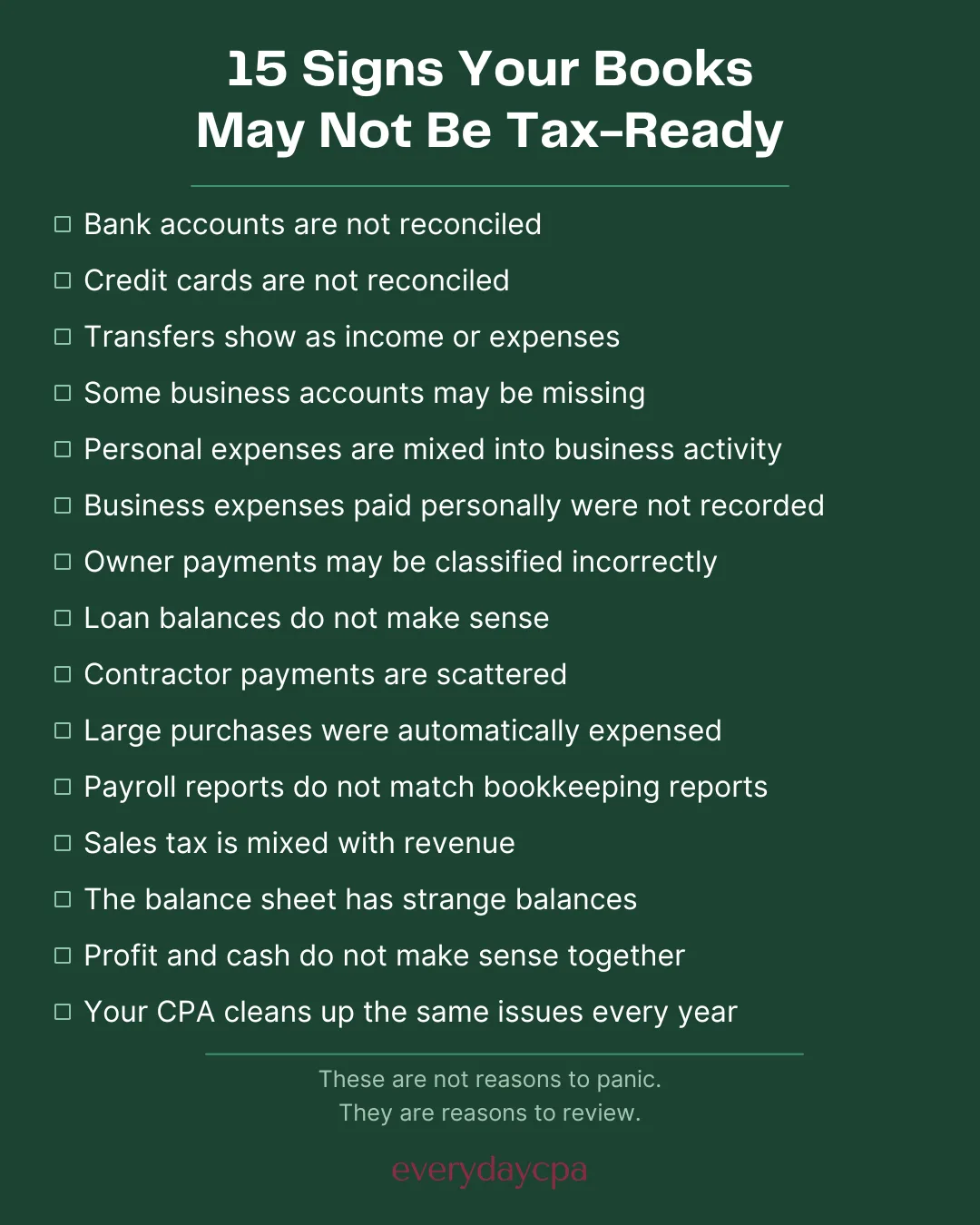
Here are practical signs your books may not be tax-ready yet:
Your bank accounts are not reconciled
Your credit card accounts are not reconciled
Transfers show up as income or expenses
You are not sure whether all business accounts are included
You have personal expenses in the business account
You have business expenses paid personally that were never recorded
You do not know whether owner payments were treated correctly
Your loan balances do not make sense
Contractor payments are scattered across categories
Large purchases were automatically expensed without review
Payroll reports do not match bookkeeping reports
Sales tax collected is mixed with revenue
The balance sheet has old or strange balances
You cannot explain why profit and cash are different
Your CPA asks for major cleanup at tax time every year
These are not reasons to panic.
They are reasons to review.
Most bookkeeping problems are fixable.
But they are easier to fix before the tax deadline.
For books that require additional correction, learn about QuickBooks cleanup and rescue.
The Better Model: AI-Assisted Compilation + CPA Review + Owner Confirmation
The future should not require business owners to do all their own accounting.
It should also not rely on AI alone.
The better model combines three things:
AI-assisted compilation
CPA review and tax-aware judgment
Business owner confirmation and context
AI helps organize the activity.
CPA review helps determine whether the information is accurate, tax-aware, and useful.
The owner confirms what actually happened in the business.
Together, those pieces create better financial clarity.
This model works because each part does what it is best suited to do.
AI brings speed.
CPAs bring judgment.
Owners bring context.
The goal is not automation for its own sake.
The goal is reliable information that helps the owner file taxes, manage cash flow, understand profit, reduce surprises, and make better decisions.
Where iPacio Fits
iPacio is built around AI-assisted compilation, CPA review, and owner confirmation — because financial clarity requires more than automation.
At EverydayCPA, we do not believe business owners should have to become bookkeepers to get tax-ready financial information.
We also do not believe AI should operate alone without review.
The right approach is a better division of labor.
AI helps compile the financial activity.
EverydayCPA’s CPA team helps review and interpret the results.
The business owner provides confirmation and business context when needed.
That combination can reduce the accounting burden on the owner while improving the quality of the information.
The result is not just clean-looking books.
The goal is tax-ready clarity.
Less accounting.
More clarity.
Better decisions.
iPacio is built around AI-assisted compilation, CPA review, and owner confirmation — because automation alone is not enough.

What Business Owners Should Do Next
The first step is to stop assuming that a clean-looking report means the books are ready.
Ask better questions.
Are the accounts reconciled?
Are deposits properly classified?
Are transfers excluded from income and expenses?
Are owner payments treated correctly?
Are personal expenses separated?
Are contractor payments reviewed?
Are large purchases flagged?
Are tax-sensitive items documented?
Are the reports useful for business decisions?
Are the books ready for tax preparation?
If you are not sure, that is a sign you may need review.
That does not mean your books are hopeless.
It means they may need professional eyes before you rely on them.
At EverydayCPA, we help business owners move beyond clean-looking reports toward tax-aware financial clarity.
If your books look organized but you still do not trust them, book a call with Kelly or Cat.
We can help you understand what needs review, what matters for taxes, and how to build a better system going forward.
Your books may look clean. Let’s make sure they are tax-ready.
FAQ
What are tax-ready books?
Tax-ready books are financial records that are organized, complete, reconciled, reviewed, and prepared in a way that supports tax return preparation and tax planning. They require more than simply categorized transactions.
Are clean books the same as tax-ready books?
No. Clean books may look organized, but tax-ready books have been reviewed for accuracy, completeness, tax-sensitive items, proper classification, reconciliations, owner payments, transfers, and documentation.
Can a profit and loss report look right but still be wrong?
Yes. A profit and loss report can look clean and still include misclassified deposits, duplicated income, incorrect expense categories, personal expenses, transfer errors, or missing documentation.
Why are AI-generated reports risky?
AI-generated reports can be risky because they may look polished before they have been reviewed. AI can organize information quickly, but it may not understand business purpose, tax treatment, owner intent, or accounting rules without proper training and review.
Can AI create tax-ready books?
AI can help compile and organize financial activity, but AI alone should not be treated as creating tax-ready books. Tax-ready books require accounting logic, tax awareness, CPA review, and owner confirmation.
What is the difference between bookkeeping and tax-ready bookkeeping?
Bookkeeping records and organizes financial activity. Tax-ready bookkeeping goes further by making sure the books are accurate, reconciled, reviewed, properly classified, documented, and ready to support tax preparation.
Why do deposits get misclassified?
Deposits get misclassified because a deposit may be revenue, a loan, a transfer, an owner contribution, a reimbursement, a refund, or another type of transaction. The bank feed alone may not provide enough context.
Why do transfers cause bookkeeping problems?
Transfers cause problems when money moving between accounts is incorrectly recorded as income or expense. This can distort revenue, expenses, profit, and cash flow.
Should a CPA review my books before taxes?
For many business owners, yes. CPA review can help identify misclassified transactions, missing deductions, owner payment issues, contractor reporting concerns, loan accounting problems, and other tax-sensitive items before the return is prepared.
How does iPacio help with tax-ready books?
iPacio is designed to use AI-assisted compilation, CPA review, and owner confirmation to help turn financial activity into clearer, more tax-aware financial information.
Want practical tax and financial clarity tips while you think it over? Download Tax Tips & Hacks free.
