
Kelly Coughlin, CPA
The Four-Part Financial Clarity Model
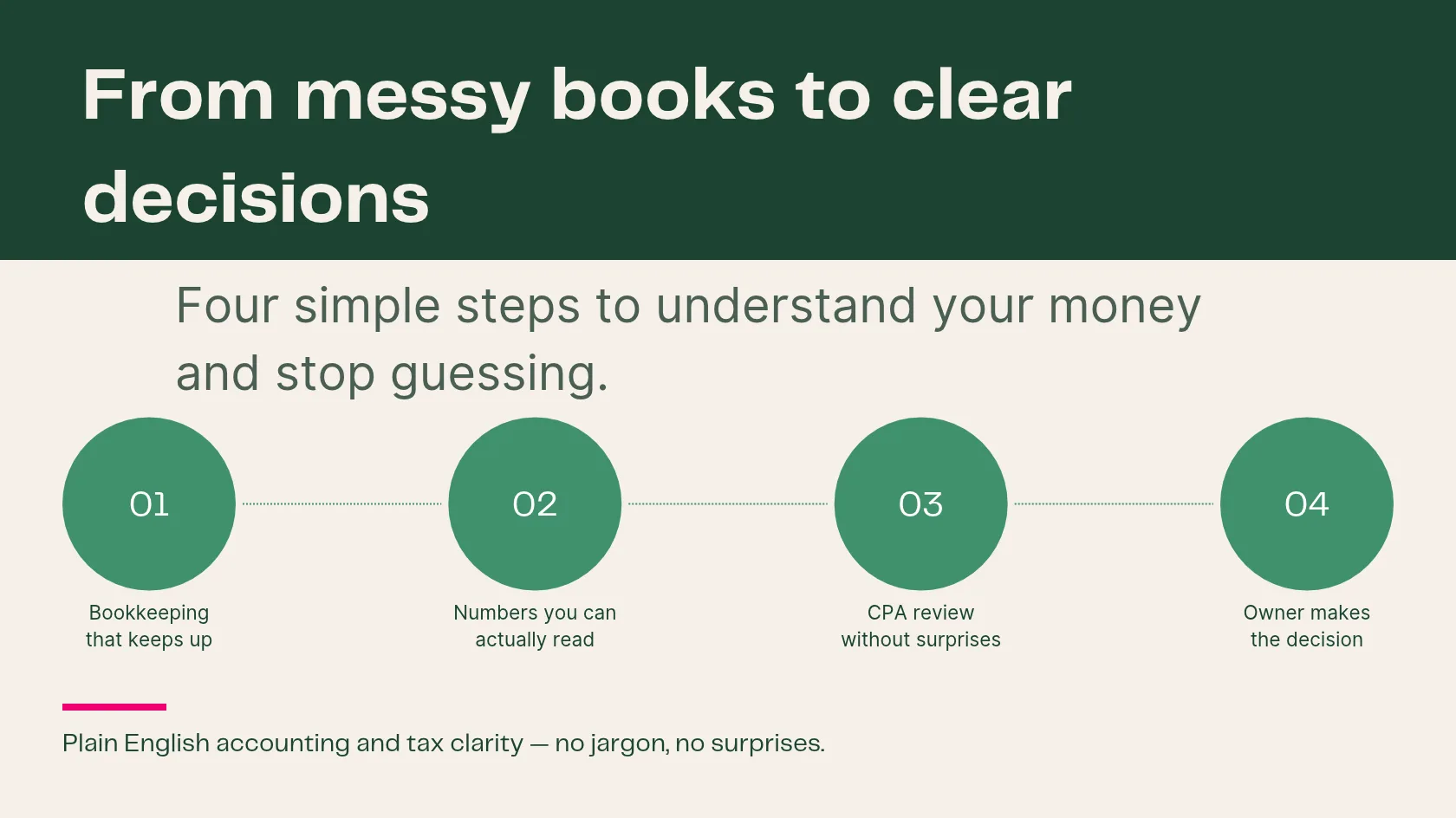
Every accounting process starts with a transaction.
A customer pays an invoice. Payroll runs. A vendor bill arrives. An owner makes a contribution. A loan payment clears. A credit card covers an equipment purchase.
The transaction is not the insight. It is the raw event that begins the process.
To become useful, the event has to move through technology, human review and judgment, and applied analysis. Only then can it help someone decide what to do.
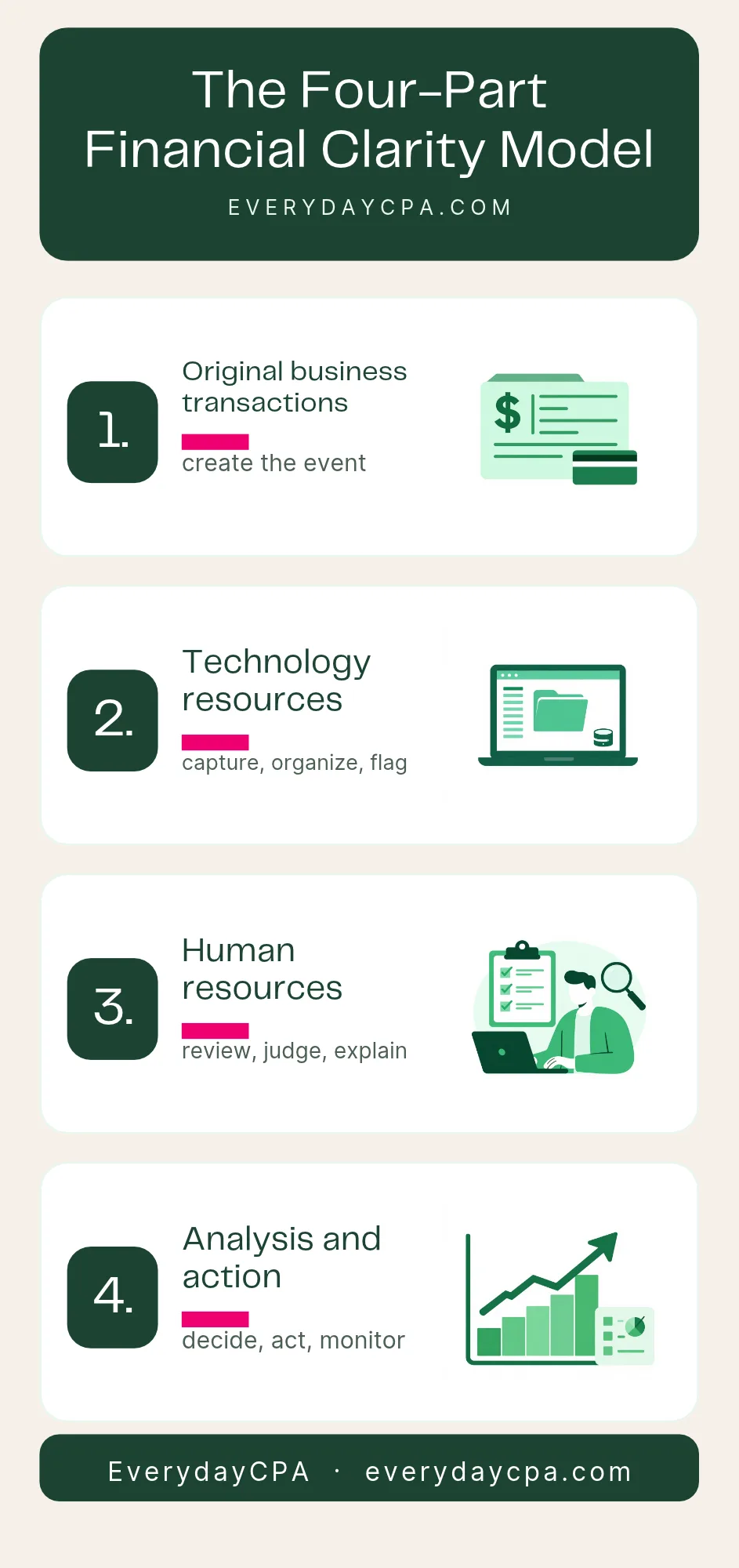
EverydayCPA organizes that progression into a Four-Part Financial Clarity Model:
Original business transactions
Technology resources
Human resources and professional judgment
Applied analysis, interpretation, and action
The model makes one principle visible: the purpose of accounting is not simply to move a transaction into a report. It is to move reliable information into a better decision.
Part 1: Original business transactions
Transactions are the economic events that create the need for accounting.
They include:
invoices and sales receipts;
customer payments and refunds;
vendor bills;
credit-card charges;
bank deposits and transfers;
payroll;
loans and loan payments;
tax payments;
owner contributions, draws, and distributions; and
purchases of equipment or other assets.
At this stage, the event exists whether the accounting system captures it correctly or not.
A $12,000 deposit reached the bank. The system still needs to determine what it represents. It could be customer revenue. It could be a loan. It could be an owner contribution, a transfer, a refund, or a deposit that carries an obligation.
The transaction is real. Its accounting meaning still requires processing and context.
What can go wrong at Part 1
An account or card is omitted.
A transaction is duplicated or missed.
Personal and business activity are mixed.
Supporting documentation is missing.
The description from the financial institution does not reveal the purpose.
The first responsibility of the system is complete, timely capture.

Part 2: Technology resources
Technology helps turn raw activity into organized information.
The technology layer may include accounting software, bank and credit-card feeds, payroll systems, invoicing tools, bill-payment systems, receipt capture, spreadsheets, document storage, dashboards, rules, and artificial intelligence.
It can assist with:
importing activity;
organizing documents;
suggesting classifications;
matching payments and invoices;
identifying recurring patterns;
supporting reconciliation;
monitoring balances;
preparing reports;
highlighting exceptions; and
summarizing what changed.
This is where AI can reduce repetitive work. It can help process a larger volume of information and direct attention toward items that do not fit the expected pattern.
Technology needs boundaries
Technology works from data, rules, patterns, and instructions. It does not automatically know every fact behind the business event.
A software suggestion may be correct. It may also lack the context that changes the accounting or tax treatment.
The right objective is not maximum automation. It is reliable automation with appropriate review.
Use technology aggressively for repeatable tasks. Preserve human attention for exceptions, risk, judgment, and decisions.
Part 3: Human resources and professional judgment
People supply authorization, context, review, correction, interpretation, and accountability.
The people involved may include the owner, employees, bookkeeper, CPA, tax preparer, controller, payroll provider, or outside advisor.
Their roles are different.
The owner
The owner explains facts the system cannot know, approves important activity, sets priorities, defines risk tolerance, and makes decisions.
The accounting team
The team maintains the process, handles exceptions, reconciles accounts, follows up on missing information, and helps protect the reliability of the records.
The CPA or tax professional
The professional evaluates complex classifications, tax-sensitive matters, entity and owner questions, risk, planning opportunities, and the meaning of the financial results.
Why judgment remains essential
Judgment is not a decorative layer added after automation. It is how the system handles facts that are incomplete, unusual, material, tax-sensitive, or connected to a consequential decision.
Professional judgment also includes knowing when not to give a simple answer. A business decision may require more documentation, a legal opinion, a valuation, an industry specialist, or a discussion of uncertainty.
A well-designed system uses technology to bring those moments forward. It does not hide them behind a confident automatic classification.
Part 4: Applied analysis, interpretation, and action
Part 4 is where the accounting becomes valuable to the owner.
The information is used to answer:
What happened?
What changed?
Why did it change?
What is unusual?
What may happen next?
What requires attention?
What decision should be made?
Analysis can include cash, revenue, margin, expenses, receivables, payables, debt, taxes, owner compensation, pricing, customer or project profitability, and operating trends.
Interpretation connects the number to the business context.
Action turns the interpretation into a result:
collect the overdue invoice;
reserve cash for taxes;
change a price;
reduce or renegotiate an expense;
delay or approve a hire;
correct the accounting process;
change the timing of a purchase;
revisit owner pay; or
seek specialized advice before acting.
The system is not finished when the report is produced. It is finished when the right person understands what requires attention and a responsible next step has been defined.
A single transaction through all four parts
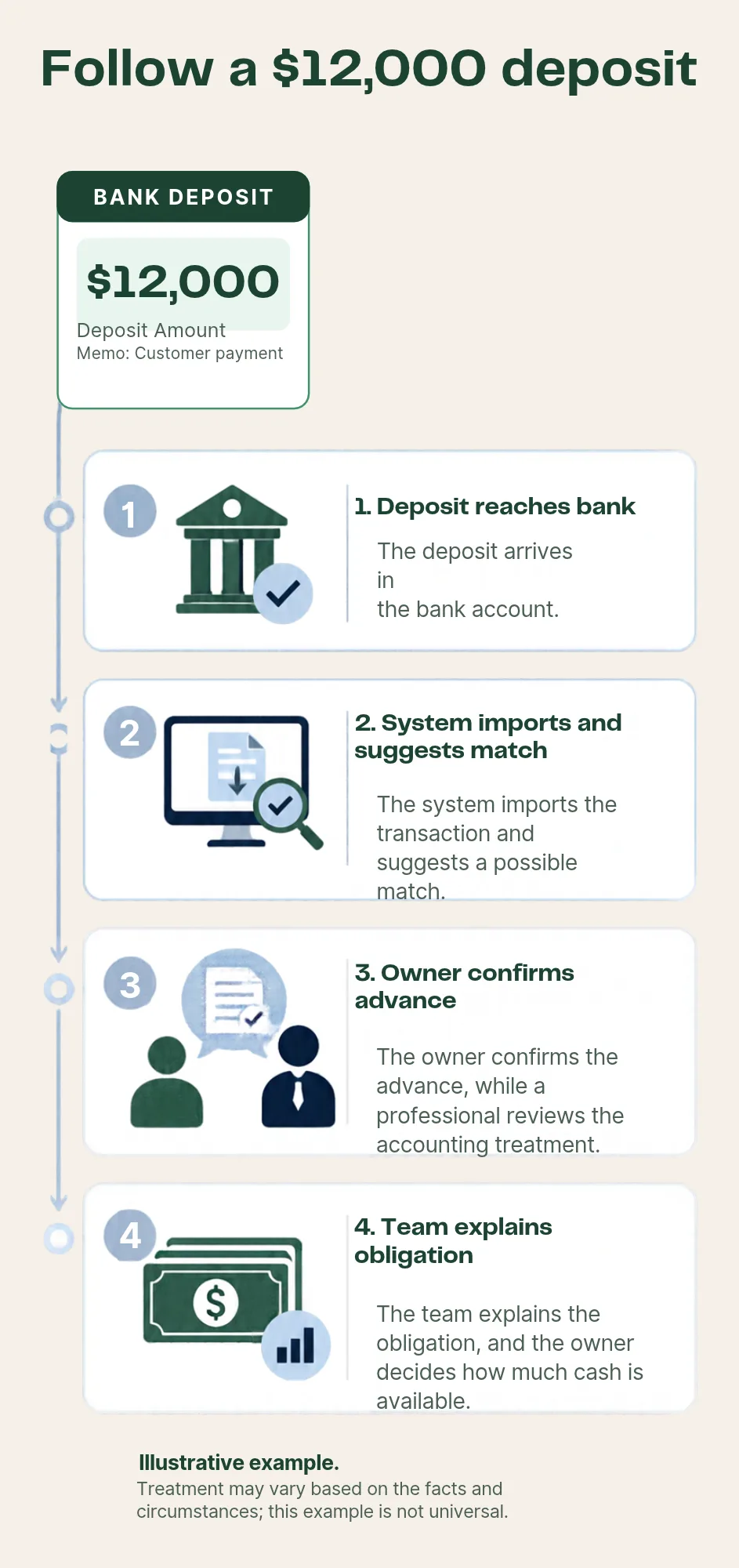
Consider a $12,000 deposit.
Transaction
The money reaches the bank.
Technology
The bank feed imports it. The system recognizes the payer, looks for an invoice, reviews prior patterns, and suggests a match or classification.
Human judgment
The owner confirms that the deposit includes an advance for work not yet completed. The accounting professional reviews whether part of the amount creates a liability rather than current revenue and considers the tax and reporting implications.
Analysis and action
The team explains how much cash is available, what obligation remains, and whether the business should reserve part of the deposit. The owner decides how to use the cash without treating the entire amount as earned and available.
The bank balance was accurate at every stage. The decision became reliable only after the transaction moved through context and judgment.

Most businesses stop too early
Some businesses stop at Part 1: the activity exists, but the records are behind.
Some stop at Part 2: the software contains the transactions and produces reports, but nobody is confident in the classifications or reconciliations.
Some stop at Part 3: the books have been reviewed and may be tax-ready, but the reports are filed away without a discussion of what they mean.
Financial clarity requires Part 4.
This does not mean every transaction deserves a strategic meeting. A good system handles routine work efficiently and brings attention to the exceptions, patterns, risks, and decisions that matter.
Where iPacio shifts the load
EverydayCPA's position is not that work disappears. The work has to occur somewhere.
iPacio is designed to help shift more capture, organization, pattern recognition, monitoring, summarization, and exception identification into a technology-enabled workflow. EverydayCPA professionals review and explain what matters. The owner provides context and decides.
That can reduce the amount of customer-side accounting labor and preserve more professional attention for interpretation, tax planning, risk, cash, profitability, and action.
The claim should remain bounded. iPacio does not eliminate human involvement, guarantee perfect classification, or replace professional judgment. The system is designed around a better division of labor.
It is also QuickBooks-compatible, not QuickBooks-dependent. The right technology configuration depends on the business. The four-part model applies regardless of which accounting product stores part of the information.
How to evaluate your current accounting process
For each part, ask one practical question.
Part 1 - Transactions
Are all relevant accounts and activities being captured completely and on time?
Part 2 - Technology
Which repetitive tasks are automated, and which exceptions does the system bring forward?
Part 3 - Judgment
Who reviews the result, supplies missing context, handles tax-sensitive items, and owns the professional judgment?
Part 4 - Action
What decision, follow-up, or change comes from the information?
If there is no clear answer at one stage, that is where the workflow needs attention.
The progression to remember
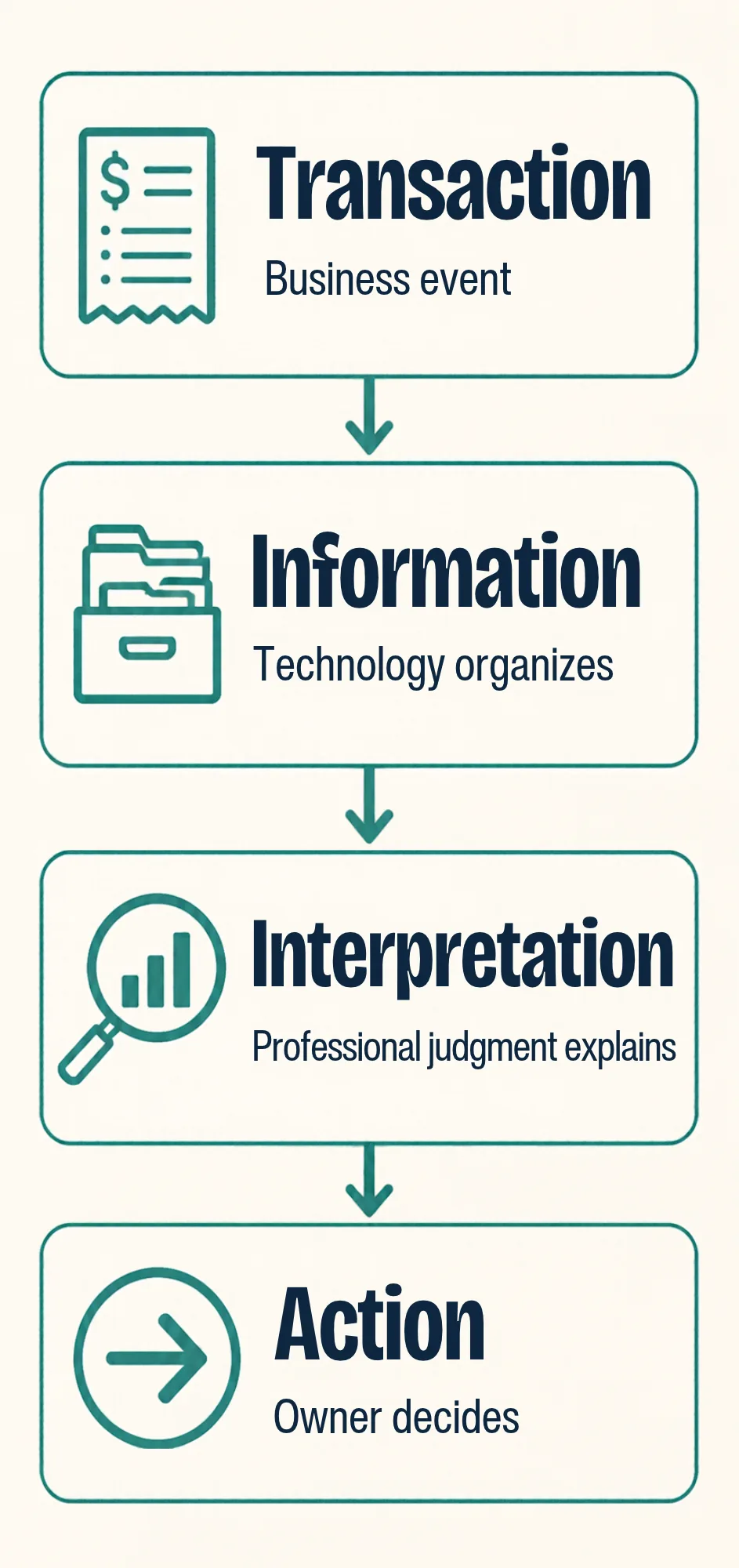
Transaction → Information → Interpretation → Action
The transaction is the raw event. Technology helps organize it into information. People review and interpret it. The owner and advisors decide and act.
That is financial clarity.
Accounting records the past. A well-designed system uses the record to improve what happens next.
Keep the Four-Part Financial Clarity Model on one page and use it to review your current process.