
Cat Glass, CPA
How Often Should You Review Financials? A Practical Rhythm

Some business owners look at the bank account every morning.
Others avoid their numbers until tax season.
Neither approach creates much clarity.
Checking constantly can turn every deposit and withdrawal into an emotional event. Waiting several months means a cash shortage, shrinking margin, or rising expense can quietly become a much bigger problem.
So, how often should you review your financials?
For most owner-led businesses, the practical answer is:
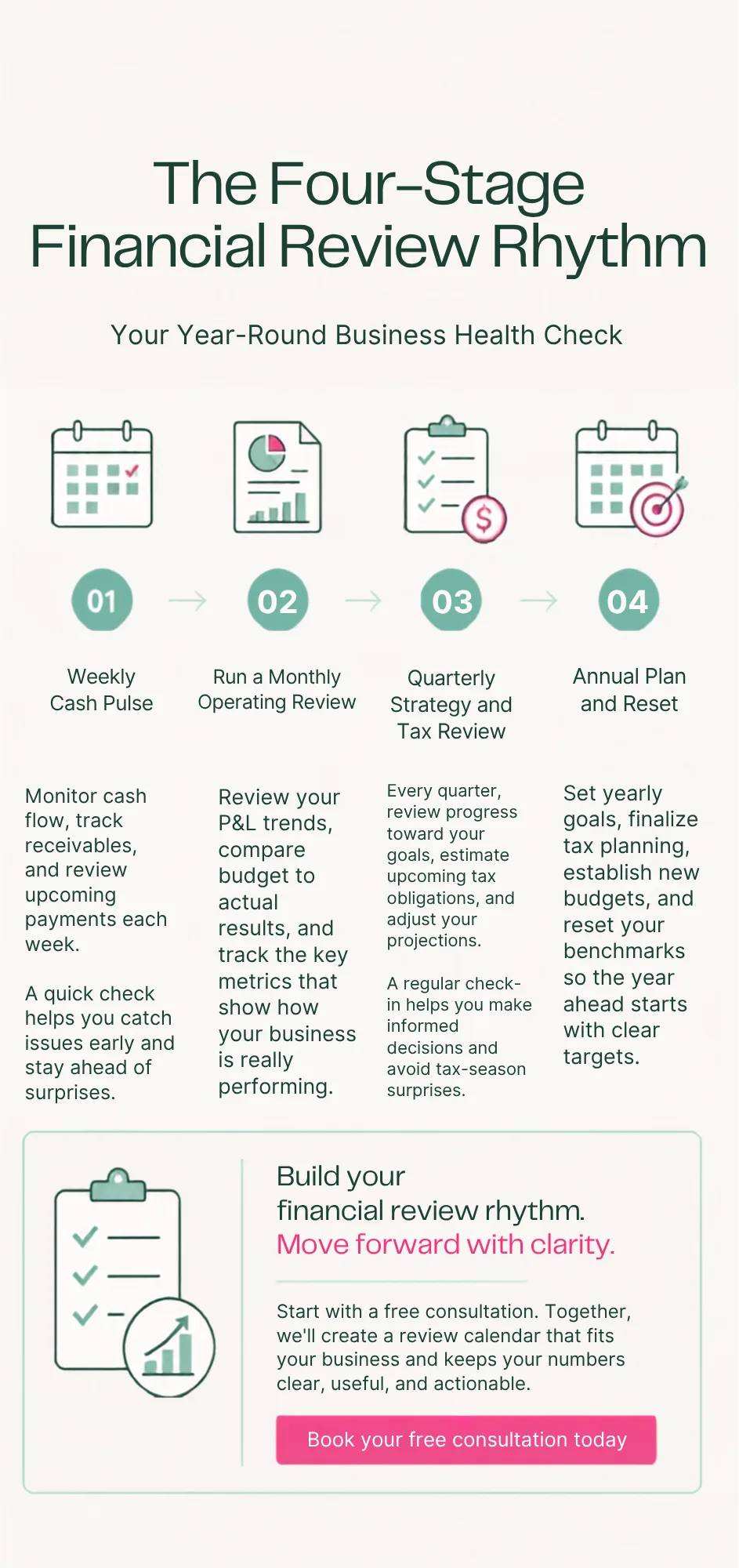
Check cash and immediate obligations weekly.
Conduct a structured monthly financial review.
Step back for a deeper strategic and tax review quarterly.
Reset plans, budgets, and long-term goals annually.
Review sooner when something important changes.
That rhythm keeps the numbers close enough to guide decisions without forcing you to become a full-time accountant.
Not Every Number Deserves the Same Schedule
"Look at your numbers" sounds like one task. It is actually several different jobs.
Your cash position answers an immediate question: Can the business meet its upcoming obligations?
Your profit and loss statement answers a period-based question: Did the business earn more than it spent?
Your balance sheet answers a cumulative question: What does the business own, owe, and retain?
Your forecast answers a forward-looking question: What is likely to happen next?
Tax planning asks another question: Based on the year so far, are you setting aside and paying enough?
Those questions operate on different clocks. That is why one giant quarterly review is usually too slow, while a full financial-statement analysis every morning is unnecessary for most businesses.
The goal is not maximum attention. It is timely attention.
Weekly: Take a Short Cash Pulse
A weekly review is not a full accounting meeting. Think of it as a cash and obligations check.
At the same time each week, look at:
Cash available across business accounts
Customer payments expected soon
Overdue receivables
Bills, payroll, debt payments, and tax payments coming due
Any unusually large or unfamiliar transactions
The next several weeks of expected cash inflows and outflows
The point is not to react to every transaction. It is to ask, "Do we have enough available cash for what is coming?"
Available cash is not always the same as the bank balance. Money in the account may already be committed to payroll, sales tax, income tax, subcontractors, debt, or upcoming bills.
A quick weekly pulse gives you time to collect a late invoice, delay a discretionary purchase, move money to a tax account, or investigate an unusual charge before the situation becomes urgent.
Businesses with tight cash, rapid growth, heavy inventory, large payrolls, seasonal revenue, or slow-paying customers may need to review cash more frequently. A stable service business with strong reserves may need less day-to-day attention.
The cadence should reflect the speed and risk of the business.
Monthly: Run the Real Financial Review
For most businesses, monthly is the right baseline for reviewing complete financial results.
SCORE training materials recommend monthly preparation and review of financial statements, while the U.S. Chamber notes that monthly reporting can help owners evaluate pricing, productivity, growth, and major spending decisions.
A monthly review creates a useful feedback loop. The period is long enough to show meaningful activity but short enough to correct a problem before another quarter disappears.
Start With Numbers You Can Trust
Do not rush to analyze reports that are still changing.
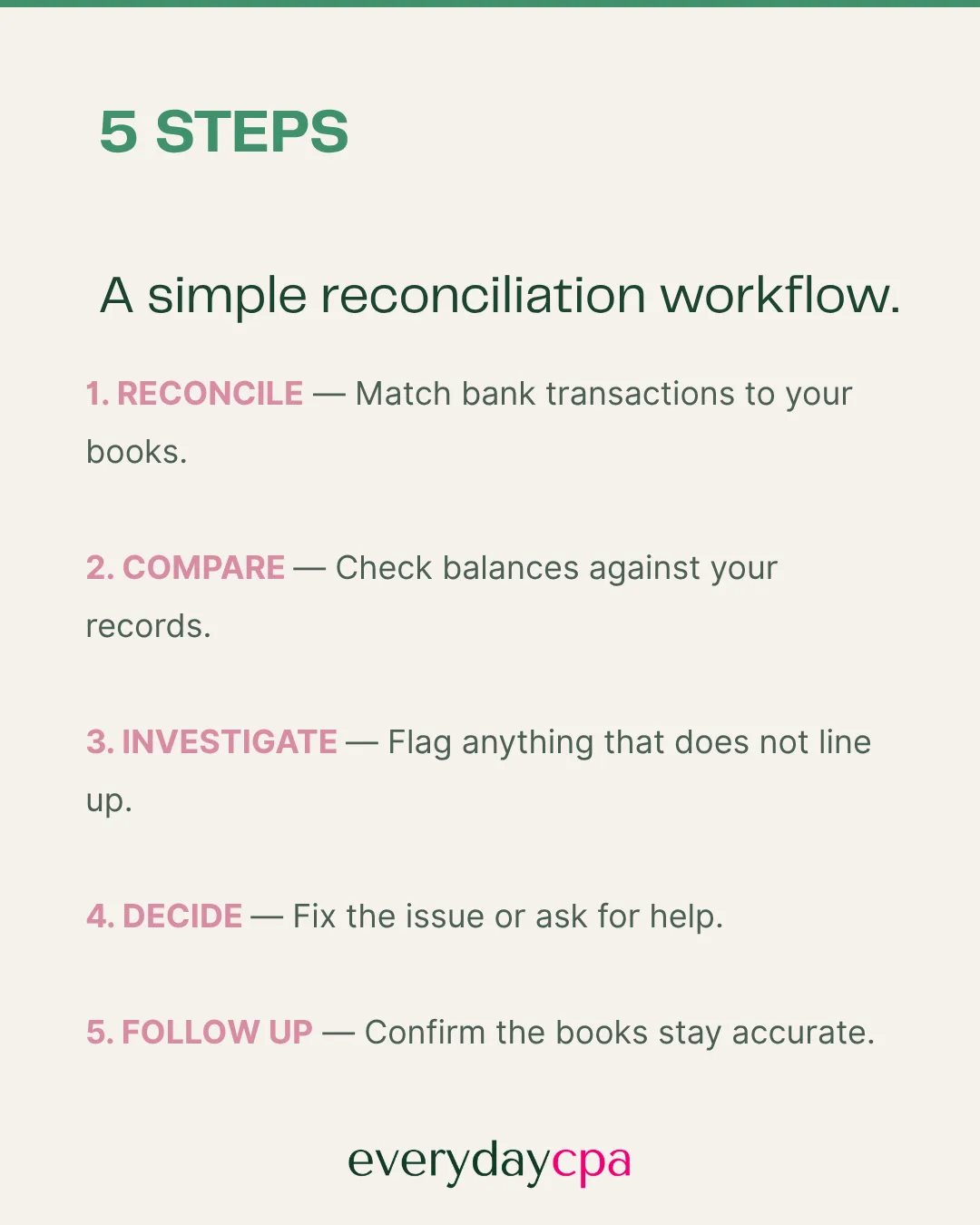
Before the review, confirm that business bank and credit-card accounts have been reconciled, major transactions have been categorized, transfers and owner activity have been handled correctly, and unusual items have been investigated.
The IRS emphasizes that business books should summarize transactions and be supported by records such as invoices, receipts, statements, and proof of payment.
Clean-looking reports are not necessarily reliable reports. A loan recorded as revenue or an owner contribution classified as sales can produce a precise but misleading profit number. Everyday CPA explains this distinction in Clean-Looking Books Are Not Always Tax-Ready Books.
Review the Story, Not Just the Totals
During your monthly financial review, examine:
Revenue compared with the prior month, prior year, and plan
Gross profit and gross margin
Major expense changes
Net profit
Cash generated or consumed
Accounts receivable and accounts payable
Debt and credit-card balances
Tax reserves and estimated payments
Owner pay, draws, or distributions
Any metrics specific to your business model
Do not stop at "revenue increased" or "expenses were high." Ask why.
Did revenue rise because of a lasting improvement or one unusually large project? Did payroll grow before the new employee became productive? Did margin fall because of discounting, vendor prices, rework, or an accounting error?
That interpretation is where financial reporting becomes useful.
End With Decisions
A monthly review should produce actions, not just observations.
For every meaningful issue, decide:
What happened?
Why did it happen?
Is it temporary or likely to continue?
What decision does it require?
Who owns the next step?
When will you check the result?
You might decide to follow up on three overdue invoices, review pricing for one service, cancel unused subscriptions, increase the tax reserve, or wait another month before hiring.
Record those decisions. Begin the next review by checking what happened.
Quarterly: Zoom Out and Challenge the Plan
Monthly reviews are good at catching movement. Quarterly reviews are better for identifying patterns.
Every three months, step back and review:
Year-to-date results against the budget or forecast
Revenue and margin trends across several months
Customer, service, project, or location profitability
Hiring and compensation decisions
Pricing and capacity
Debt, capital purchases, and cash reserves
Estimated taxes and year-end planning opportunities
The forecast for the next two or three quarters
This is also a good time to ask whether the metrics you are watching still match the business's most important constraint.
Perhaps revenue is growing, but collections are slowing. Maybe profit looks stable, but one service line is carrying the others. Maybe the business can afford another employee but does not yet have enough consistent demand for the role.
Quarterly review lets you distinguish a strange month from a genuine trend.
It also creates a natural tax-planning checkpoint. Federal income tax is generally pay-as-you-go, and estimated-payment requirements depend on factors including entity type and expected liability. IRS Publication 583 provides general recordkeeping and tax guidance. Review your particular situation with a qualified tax professional rather than relying on a generic percentage or deadline.
Annually: Reset the Direction
An annual review should do more than confirm what happened last year.
Use it to establish the next year's operating plan:
Set revenue, profit, cash, and owner-compensation goals
Build or revise the budget
Review pricing and service mix
Plan major hiring and purchases
Evaluate debt and cash-reserve targets
Review entity structure and tax strategy
Identify the few metrics that will guide the coming year
Decide what the owner wants the business to provide personally
Annual planning provides direction. Monthly reviews tell you whether the business is following that direction. Quarterly reviews tell you whether the direction still makes sense.
Without the shorter feedback loops, the annual plan can become a document nobody looks at again.
Review Immediately When the Business Changes
A calendar is the minimum schedule, not a reason to ignore new information.
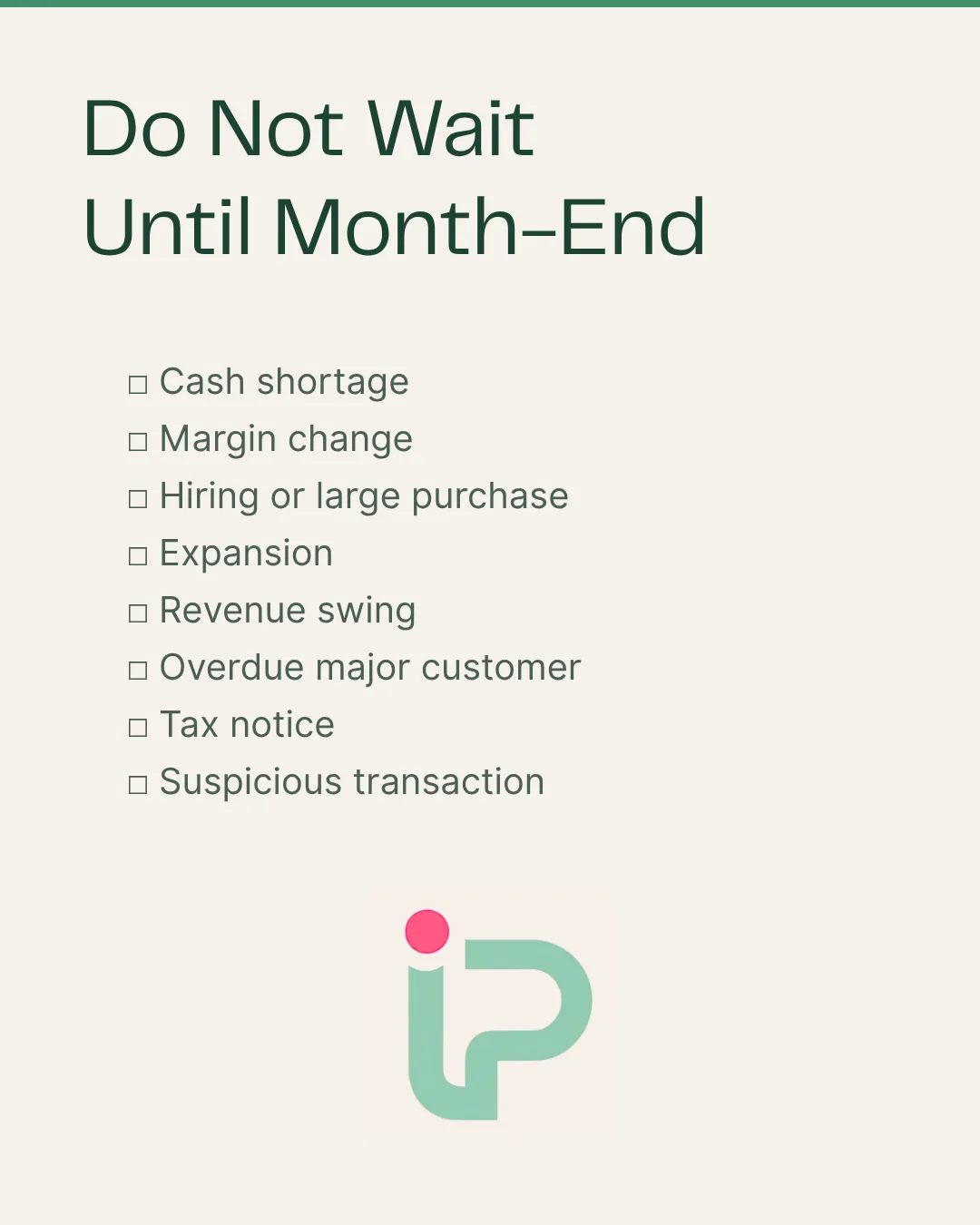
Run an additional review when:
Cash becomes unexpectedly tight
Revenue rises or falls sharply
Gross margin changes materially
A major customer is lost or becomes slow to pay
You are considering a hire, loan, lease, or large purchase
You plan to open or close a location
You launch a new service or pricing model
The business experiences fraud, theft, or unusual transactions
You receive a tax notice
Your books no longer match what you see in the business
The bigger and less reversible the decision, the more current and reliable your numbers should be.
Can You Review Your Numbers Too Often?
Yes, especially when frequent checking causes you to react to incomplete information.
A single large expense may make one day look terrible. A customer deposit may make the bank balance look unusually strong. Revenue early in the month may not yet reflect the costs required to produce it.
Daily checking becomes harmful when it leads to impulsive spending cuts, unnecessary panic, or major decisions based on temporary timing.
Use frequent checks for immediate risks. Use complete monthly information for operating decisions. Use quarterly trends for strategy.
That separation reduces both surprises and noise.
What If Your Books Are Always Behind?
You cannot run a meaningful monthly financial review if the previous month is still being cleaned up several months later.
That does not mean you need to take over the bookkeeping.
It means the financial process needs clear ownership and deadlines. Someone should be responsible for collecting missing information, reconciling accounts, resolving unusual transactions, preparing reports, and explaining what changed.
The owner's role is different. The owner supplies context, asks questions, and makes decisions.
That division of labor reflects Everyday CPA's broader approach to financial clarity: bookkeeping records what happened, while clarity explains what it means and what to do next.
A Simple Financial Review Rhythm
Here is a workable starting point:
Weekly, 10-15 minutes: Review available cash, upcoming obligations, receivables, and unusual activity.
Monthly, 45-60 minutes: Review reconciled financial statements, compare results, investigate important changes, and document decisions.
Quarterly, 90-120 minutes: Analyze trends, update forecasts, review strategy, and discuss tax exposure.
Annually: Build the budget and operating plan, evaluate long-term decisions, and complete year-end tax and financial planning.
The exact time matters less than consistency. A short review that happens every month is more useful than an elaborate dashboard nobody trusts or opens.
You Need a Rhythm, Not More Accounting Homework
The right answer to "How often should I review my financials?" is not "constantly."
It is often enough to catch problems while they are still manageable and thoughtfully enough to turn the information into action.
For most businesses, that means a weekly cash pulse, a monthly financial review, a quarterly deep dive, an annual reset, and extra attention when conditions change.
You do not need to memorize every accounting term or live inside QuickBooks. You need accurate information, a repeatable rhythm, and someone who can help translate the numbers into decisions.
That is the role iPacio is designed to fill: weekly visibility, owner-focused reports, monthly decision support, tax-ready records, and CPA-led review.
To build a financial review rhythm around your actual business, book a conversation with Kelly or Cat. For more plain-English guidance on books and taxes, download Tax Tips & Hacks.
This article is general educational information, not individualized accounting, tax, legal, or financial advice. Review decisions and compliance requirements with a qualified professional familiar with your circumstances.
Frequently Asked Questions
How often should a small business review its financial statements?
Most owner-led businesses should review complete financial statements monthly. Cash, receivables, and upcoming obligations may deserve a shorter weekly check, while strategic and tax matters benefit from a deeper quarterly review.
Is a quarterly financial review enough?
Quarterly-only reviews can work for unusually stable businesses with strong internal financial oversight, but they may allow cash, margin, or expense problems to continue for several months. A light monthly review plus a deeper quarterly review is usually more useful.
What should be included in a monthly financial review?
Review reconciled financial statements, revenue, margins, major expenses, profit, cash flow, receivables, payables, debt, tax reserves, owner compensation, and meaningful differences from the budget or prior periods. Finish by recording decisions and owners.
Should I check my business bank account every day?
You can monitor it for fraud and immediate cash risks, but a bank balance does not explain profitability, future obligations, taxes, or cash-flow timing. Do not use it as your only measure of financial health.
How soon after month-end should I review the numbers?
Review them as soon as the accounts are reconciled and material questions are resolved. A fast report is not useful if the underlying transactions are incomplete or incorrect.