
Kelly Coughlin, CPA
The True Cost of DIY Bookkeeping
The software bill is probably the smallest part of what bookkeeping is costing you.
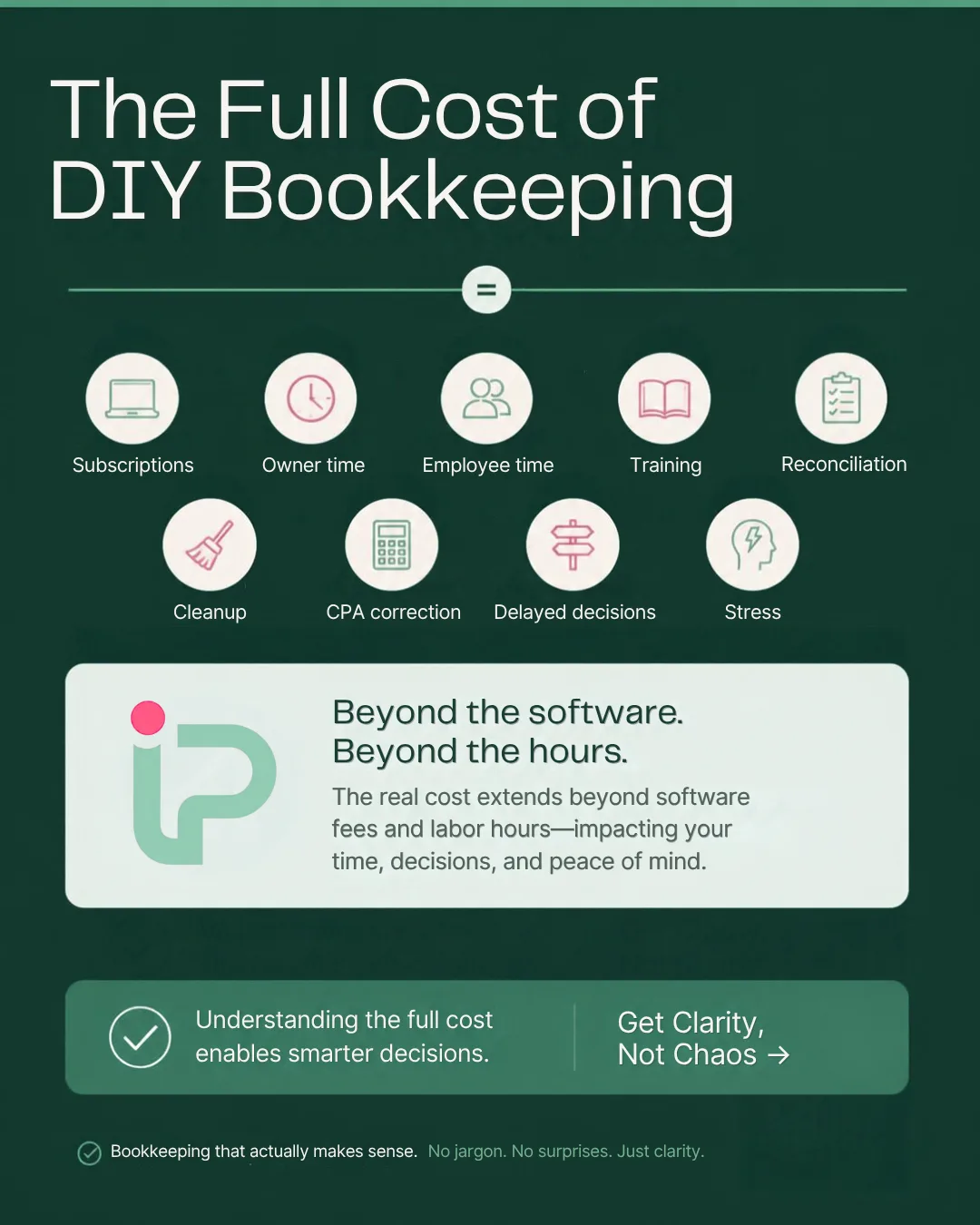
A monthly subscription is easy to see. The larger costs are spread across the owner, an employee, a bookkeeper, the CPA, and the decisions that get delayed while everyone tries to reconstruct what happened.
That does not mean every business should outsource every accounting task. A simple, disciplined owner may be able to maintain a straightforward system effectively.
It does mean the decision should be based on the full cost, not the price shown on the software page.
Start with the visible cost
The visible cost includes accounting software, receipt tools, payroll add-ons, payment applications, data storage, training subscriptions, and other systems used to keep the records moving.
These expenses are real. They are also usually the easiest part to measure.
The owner sees a monthly invoice and concludes, “My bookkeeping costs $40, $80, or $150 a month.”
That number leaves out the people doing the work.
Count the owner's time
Owner time is not free because the owner does not receive an hourly paycheck.
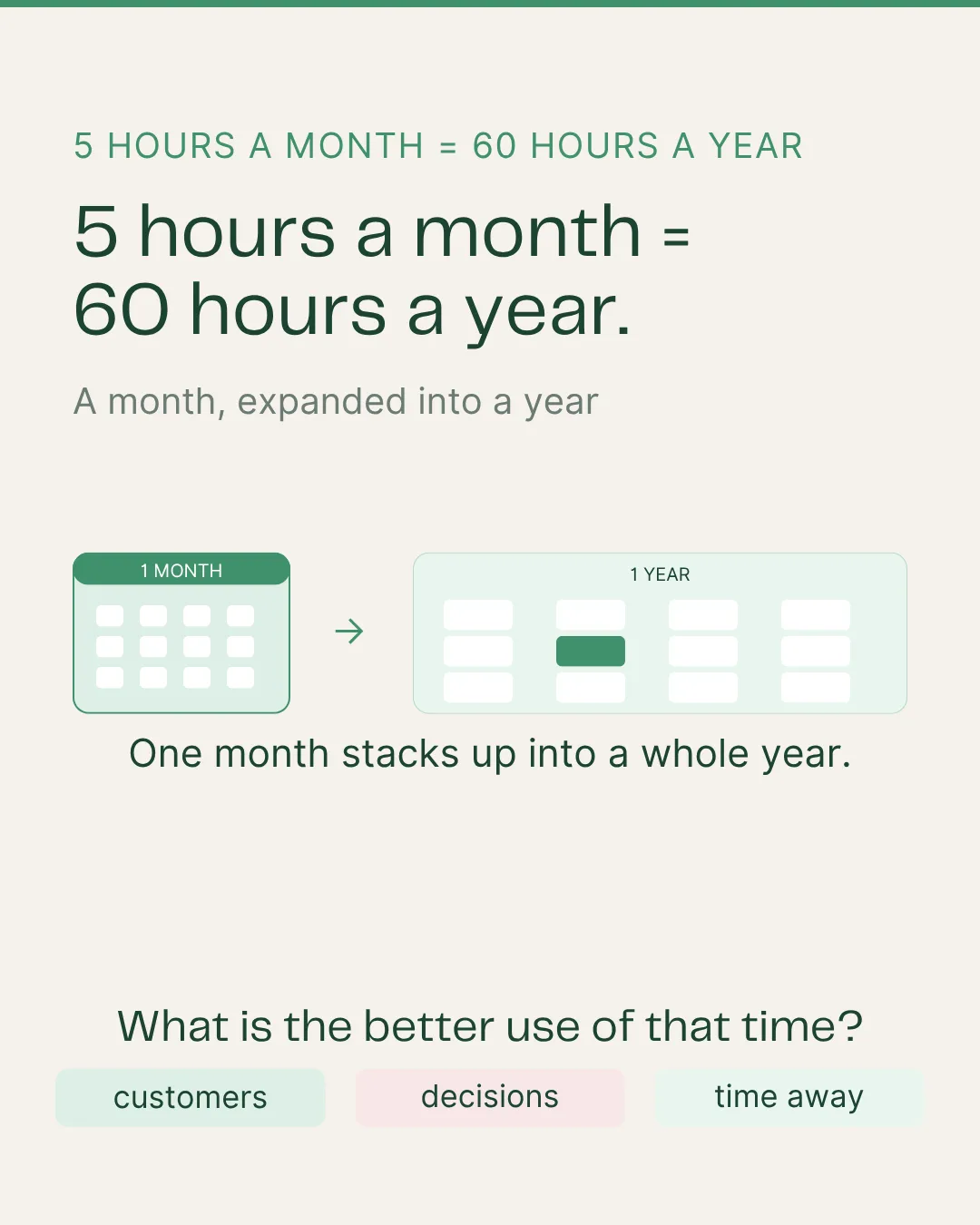
If bookkeeping takes five hours each month, that is 60 hours a year. Add time spent finding receipts, answering employee questions, fixing sync problems, checking categories, preparing for taxes, and talking through old transactions. The total can rise quickly.
The useful calculation is not simply hours multiplied by an imaginary executive rate. Ask what the owner could reasonably have done with that time:
complete billable work;
follow up with prospects;
improve a process;
collect a slow invoice;
review pricing;
train an employee;
rest enough to make a better decision; or
spend time away from the business without worrying about the books.
Opportunity cost is not always a dollar that would have appeared immediately. It is the value of the better use that never happened.

Count employee time, too
DIY bookkeeping often becomes shared bookkeeping.
An office manager downloads statements. A salesperson looks for a receipt. An operations employee explains a vendor. Someone exports a report for the CPA. Another person checks whether the invoice was paid.
Each task may take only a few minutes. Across a year, the interruptions add up.
Employee time also creates coordination cost. If responsibilities are unclear, the same transaction may be touched by several people. If nobody owns the process, everyone assumes someone else handled it.
A good cost estimate includes:
recurring processing time;
questions and interruptions;
document collection;
manager review;
rework; and
the time required to explain the system to a new employee.
Training is part of the price
Accounting software is easier to use than it once was. That does not make accounting logic automatic.
Someone still has to understand:
how revenue should be recorded;
how payments match invoices;
how transfers differ from income or expense;
why loans and owner contributions do not belong in sales;
how to treat asset purchases;
what reconciliation confirms; and
which questions need professional review.
Training time includes tutorials, support calls, trial and error, and the period in which the person is doing the task slowly because the workflow is unfamiliar.
When the software changes or the employee leaves, part of that investment begins again.
Reconciliation and review cannot be skipped safely
Importing transactions is not the same thing as reconciling the accounts.
Reconciliation confirms that the accounting records agree with the bank or credit-card statement. It helps identify missing transactions, duplicates, old items, and balances that do not make sense.
That work takes time. Avoiding it does not eliminate the cost. It postpones the cost and usually makes the eventual review harder.
The same is true for balance-sheet accounts, loans, payroll liabilities, receivables, payables, and owner activity. If they are ignored until year-end, the business may operate for months using reports that look complete but contain unresolved problems.

Cleanup is expensive because history loses context
A transaction is easiest to explain when it is recent.
Six months later, the receipt is harder to find. The employee who made the purchase may not remember it. The vendor name on the bank feed may be vague. The owner may have to search email, text messages, calendars, and old statements to reconstruct the purpose.
Cleanup work therefore costs more than the original task would have cost. It combines accounting labor with investigation.
The cost may include:
catch-up entry;
reclassification;
duplicate removal;
missing-document searches;
reconciliation of several periods at once;
correction of opening balances;
payroll or sales-tax follow-up; and
a second review before the tax return can begin.
The longer the delay, the more likely the work becomes a year-end reconstruction project.
CPA correction is different from CPA judgment
A CPA can spend time correcting the records or applying professional judgment to the business.
Both kinds of work may be necessary. They do not create the same value.
Correction includes tracing unexplained balances, fixing duplicate revenue, separating loan activity, reconciling old accounts, and making the file usable for the return.
Judgment includes evaluating tax treatment, planning estimates, discussing entity choices, interpreting profitability, considering owner compensation, managing risk, and helping the owner act.
When the accounting budget is consumed by cleanup, less capacity remains for the work that can influence the future.
This is one reason EverydayCPA argues for using technology to reduce repetitive production and reserving professional attention for interpretation, planning, accountability, and action.
Delayed decisions have a cost
Some of the most important DIY bookkeeping costs never appear on an invoice.
If the owner does not trust the reports, a price change may be delayed. A slow-paying customer may remain unnoticed. Hiring may happen too early or too late. A tax payment may become a surprise. An unprofitable service may continue because no one can see the margin clearly.
These are not guaranteed losses. They are decision risks created by late, incomplete, or misunderstood information.
The cost of accounting should therefore be evaluated against the timing and usefulness of the output:
How current is the information?
Does the owner trust it?
Does it show what needs attention?
Can it support a decision before the decision becomes urgent?
A cheap process that produces late answers can be very expensive.
Stress belongs in the calculation
Accounting stress is not a soft issue when it changes behavior.
An owner who dreads opening the software may postpone the work. Someone who does not trust the books may avoid reviewing them. A tax question left unresolved can sit in the background for months. The owner may feel less secure even when the business is doing well because there is no dependable way to see it.
A better accounting system should create more than organized records. It should create:
fewer surprises;
greater confidence;
easier organization;
a clear person to ask;
trust that the work is being reviewed; and
peace of mind that important issues are not being ignored.
No system eliminates uncertainty. A good one reduces avoidable uncertainty.
A practical DIY bookkeeping cost calculation
Use the following worksheet for one typical month.
Technology
Add software, payroll, receipt, payment, storage, and other accounting-related subscriptions.
Owner time
Estimate hours spent entering, reviewing, searching, fixing, coordinating, and preparing information. Multiply by a conservative value for the owner's time or by the value of a realistic alternative use.
Employee time
Estimate all staff time spent on the workflow, including interruptions and management review. Use fully loaded compensation if available.
Outside support
Add bookkeeper, consultant, support, and CPA costs attributable to recurring production and correction.
Annual cleanup allocation
Take the expected year-end or catch-up cost and divide it by 12. This prevents the April invoice from disappearing from the monthly comparison.
Decision-delay estimate
List one or two decisions that were delayed because the information was not ready. Do not invent a dollar amount if it cannot be supported. Record the consequence: extra interest, late collection, owner time, pricing delay, tax surprise, or missed attention.
Stress and operational burden
Score the current process from 1 to 5 on confidence, ease of organization, timeliness, and peace of mind. This is not an accounting entry. It is a management signal.

When DIY may still make sense
DIY bookkeeping can be reasonable when the business is simple, transaction volume is low, the owner understands the process, accounts are reconciled consistently, tax questions receive qualified review, and the time commitment remains small.
It becomes less attractive when:
the owner is regularly behind;
several people touch the process;
transaction volume or complexity has grown;
the owner does not trust the reports;
cleanup repeats every year;
the CPA spends the engagement reconstructing history; or
important decisions wait for better numbers.
The right answer depends on the business. The calculation should include the entire system.
A better division of labor
Technology should take more repetitive work off the owner. The accounting team should maintain the process, handle exceptions, and apply judgment where it matters. The owner should provide business context and make decisions.
At EverydayCPA, iPacio helps us move toward that model. It is our proprietary financial-clarity platform, not standalone software for the owner to manage. It can help organize activity and surface what needs attention. EverydayCPA professionals help review and explain the result.
The outcome we are pursuing is simple: less stress, fewer surprises, and clearer answers without asking the owner to become a better bookkeeper.
Find the real starting point
If you are unsure what your current records reveal, start with a limited review rather than another software purchase.
A Business Intelligence Snapshot can help identify what is visible, what is missing, which patterns deserve attention, and what the next accounting or tax conversation should address.
The cheapest subscription can become an expensive accounting system when the owner, employees, and CPA spend the year compensating for the gaps.
Measure the whole cost. Then decide where your time belongs.
Get a plain-English view of what your recent financial activity may be showing: