
Kelly Coughlin, CPA
The Future Is Not AI Replacing CPAs
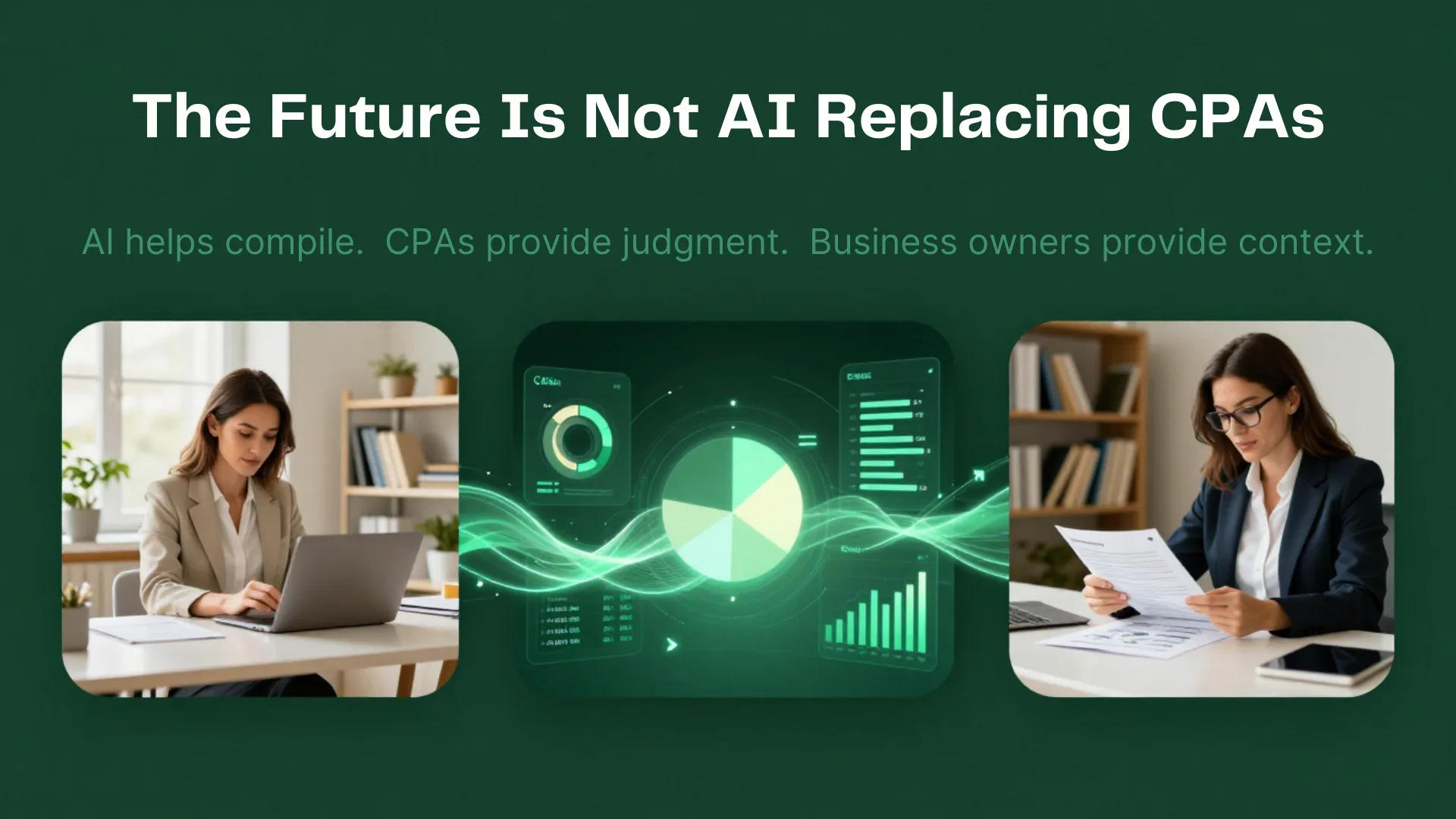
I do not believe the future is business owners doing all of their own accounting.
And I do not believe the future is AI replacing CPAs.
The future is a better division of labor.
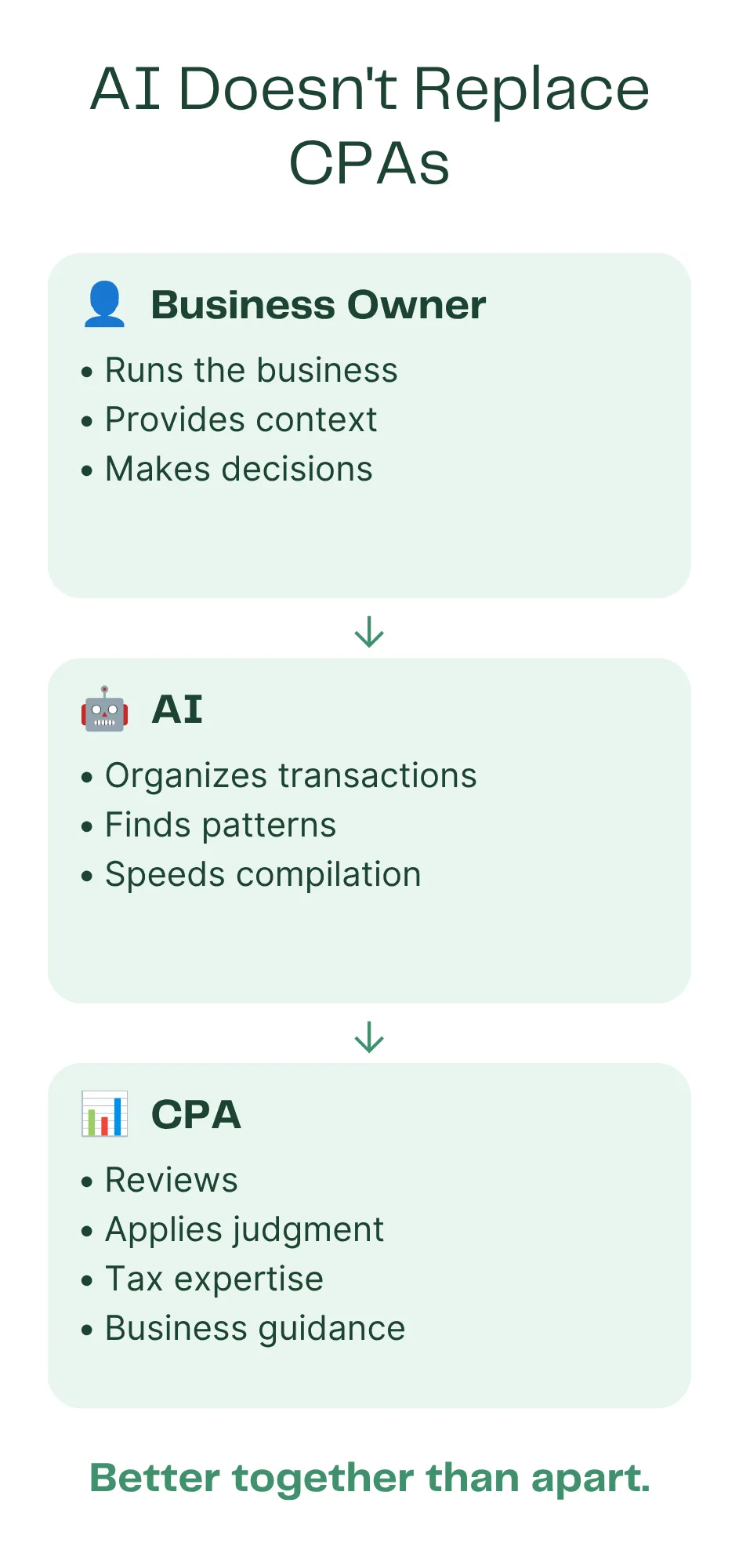
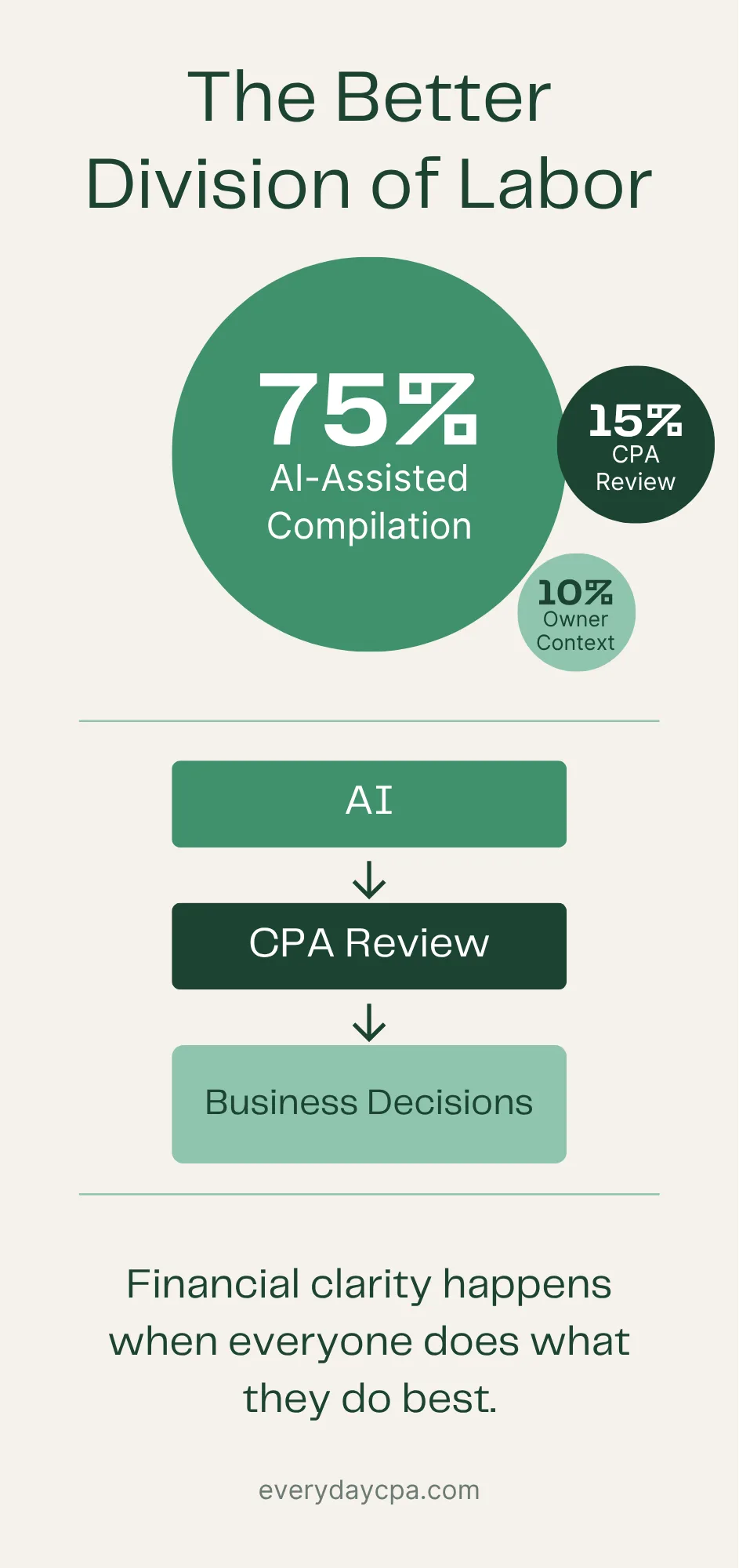
The business owner runs the business.
AI helps compile the financial activity.
Subject matter experts train and review the AI process.
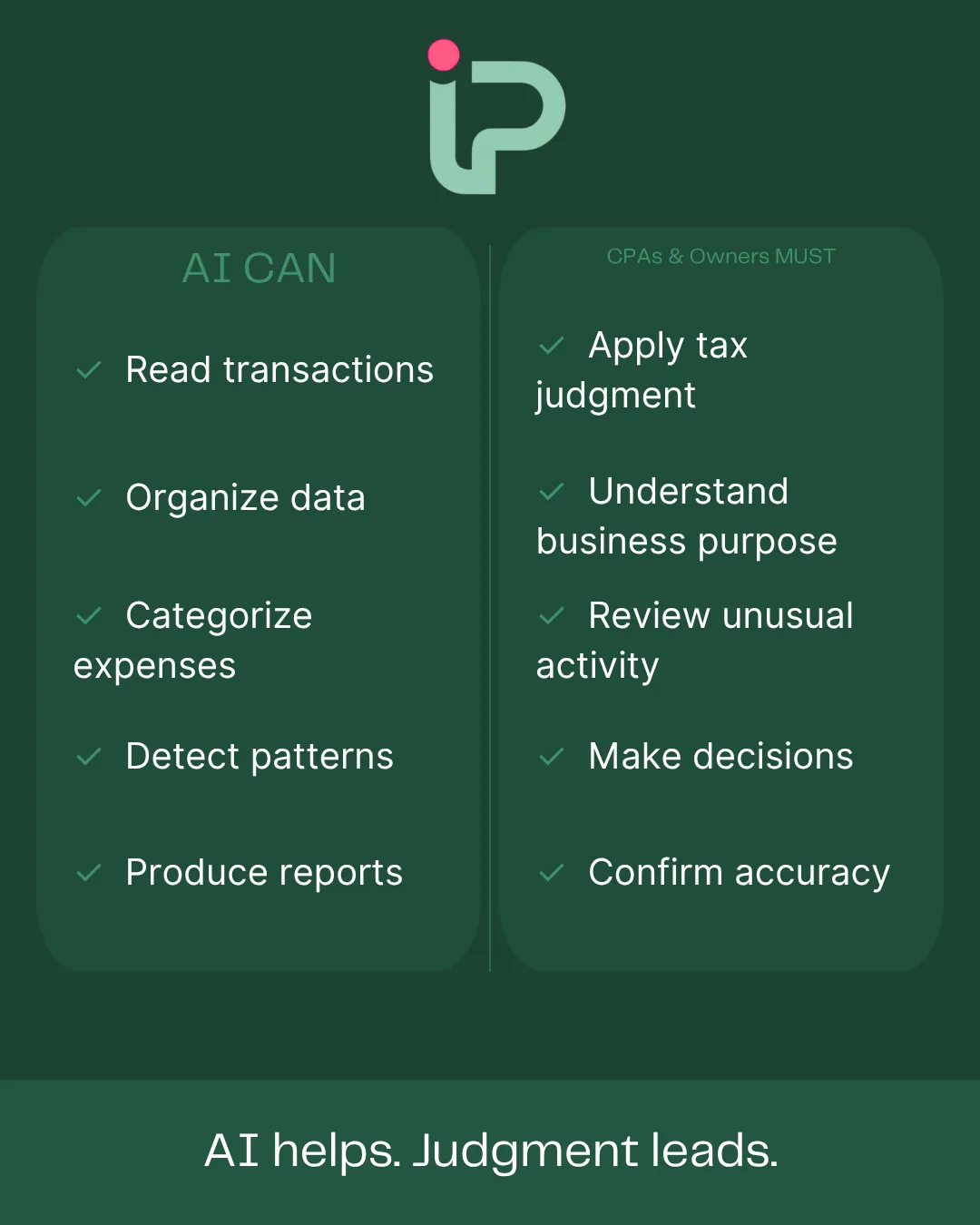
The CPA provides judgment, tax knowledge, and business guidance.
The owner provides confirmation and context.
That is the future we should be building toward.
Not owner-do-it-yourself accounting.
Not AI-only accounting.
Not more software confusion.
Not another dashboard that looks impressive but leaves the owner wondering what the numbers actually mean.
The better model is AI plus expertise.
AI plus CPA judgment.
AI plus owner knowledge.
Because business owners do not need more accounting burden. They need better financial clarity.
They need to know what happened, what matters, what taxes might look like, what risks exist, and what decisions they should consider next.
AI can help get them there faster.
But AI alone is not enough.

Table of Contents
Why the “AI Replacing CPAs” Question Is Too Simple
What AI Can Do Well in Accounting
What AI Still Cannot Do by Itself
Why Business Owners Should Not Be the Bookkeepers
Why CPAs Should Not Be Used Only for Data Cleanup
The Better Division of Labor
The 75 / 15 / 10 Model
Why the Owner’s 10% Still Matters
Why CPA Review Still Matters
Why AI-Assisted Accounting Can Be Better Than Traditional Accounting
What This Means for Business Owners
What This Means for CPAs
Where iPacio Fits
What Business Owners Should Do Next
FAQ
Why the “AI Replacing CPAs” Question Is Too Simple
A lot of people are asking whether AI will replace CPAs.
It is a fair question, but it is too simple.
AI will replace some tasks.
AI will change workflows.
AI will reduce repetitive accounting work.
AI will make some old processes look inefficient.
AI will probably force CPAs, bookkeepers, tax professionals, and accounting firms to rethink how they deliver value.
But that does not mean AI replaces professional judgment.
There is a difference between replacing tasks and replacing responsibility.
There is a difference between processing information and understanding what the information means.
There is a difference between summarizing transactions and applying tax judgment.
There is a difference between a fast answer and a reliable answer.
That is why the better question is not:
“Will AI replace CPAs?”
The better question is:
“How should AI, CPAs, and business owners work together to create better financial information?”
That is the question that matters.
Business owners have needed better financial information for decades. They need it faster, cheaper, and in plain English. They need help understanding cash flow, profitability, taxes, business activity, and decisions.
AI can help.
But the goal is not to remove judgment from the process.
The goal is to reduce the low-value work so judgment can be used where it matters most.
What AI Can Do Well in Accounting
AI can be very useful in accounting when it is used correctly.
It can process information quickly.
It can read transaction data.
It can identify patterns.
It can suggest categories.
It can flag unusual activity.
It can summarize financial activity.
It can reduce repetitive work.
It can help organize raw business activity into something more useful.
For business owners, that matters because accounting has often been slow, expensive, and frustrating.
Many owners have had to choose between doing the work themselves, hiring a bookkeeper, paying a CPA to clean things up later, or ignoring the problem until tax season.
That is not a great system.
AI can help improve that system.
It can help move financial information from raw transaction activity toward organized records more efficiently.
It can help reduce the time required to compile information.
It can help surface issues that need review.
It can help CPAs and advisors spend less time digging through data and more time applying judgment.
That is valuable.
But it is only valuable if the information is reviewed and interpreted correctly.
AI is powerful as a tool.
It is not the final authority.
What AI Still Cannot Do by Itself
AI does not automatically know your business.
It does not automatically know your entity structure.
It does not automatically know your tax situation.
It does not automatically know your goals.
It does not automatically know whether you are trying to grow, simplify, hire, reduce taxes, improve cash flow, or prepare for a financing conversation.
It does not automatically know the story behind every transaction.
A deposit may look like revenue, but it may be a loan, transfer, owner contribution, reimbursement, refund, or capital contribution.
A payment may look like an expense, but it may be personal, capitalized, reimbursable, payroll-related, loan-related, or subject to special tax treatment.
A clean-looking report may still hide tax issues.
A dashboard may look polished and still be misleading.
A category may look reasonable and still be wrong.
That is why AI alone is not enough for reliable business and tax clarity.
AI can process.
AI can suggest.
AI can summarize.
AI can assist.
But accounting and tax still require judgment, context, and responsibility.
That is where CPAs and trained subject matter experts still matter.
Why Business Owners Should Not Be the Bookkeepers
Business owners create the activity.
They sell the product. Provide the service. Pay the bills. Receive the money. Use the credit card. Pay the contractor. Move money between accounts. Approve payroll. Buy materials. Accept customer payments.
That is the owner’s world.
The owner knows the business purpose behind the activity.
But the owner should not have to personally perform all the bookkeeping work.
Most business owners did not start companies because they wanted to reconcile bank accounts, manage charts of accounts, classify transactions, fix bank feed problems, review balance sheets, or prepare tax-ready books.
They started businesses because they wanted to build something valuable.
The owner’s role should be to provide business context and make decisions.
Was this transaction authorized?
Was this purchase business-related?
Was this deposit a customer payment or a transfer?
Was this expense personal or business?
Was this contractor working on client work or internal work?
Was this unusual transaction legitimate?
Those are good owner questions.
But the owner should not have to become the accounting department.
That is the old burden.
The better model uses AI and professional review to reduce that burden.
Why CPAs Should Not Be Used Only for Data Cleanup
The traditional model also misuses CPAs.
In many businesses, the CPA gets involved too late.
The owner struggles with bookkeeping all year. QuickBooks gets messy. Transactions are misclassified. Reconciliations fall behind. The balance sheet becomes confusing. Tax season arrives.
Then the CPA has to clean up the mess.
That is not the best use of CPA judgment.
CPAs are most valuable when they help interpret, plan, review, and advise.
They can help answer questions like:
What does the profit actually mean?
What should the owner set aside for taxes?
Are estimated payments on track?
Are deductions properly captured?
Is the entity structure still appropriate?
Are owner payments being handled correctly?
Are there payroll, sales tax, or contractor reporting issues?
What should the owner consider before year-end?
What decisions should change based on the numbers?
Those are higher-value questions.
AI can help reduce the repetitive compilation work so CPAs can spend more time on judgment.
That is better for the business owner.
It is also better for the CPA profession.
The Better Division of Labor
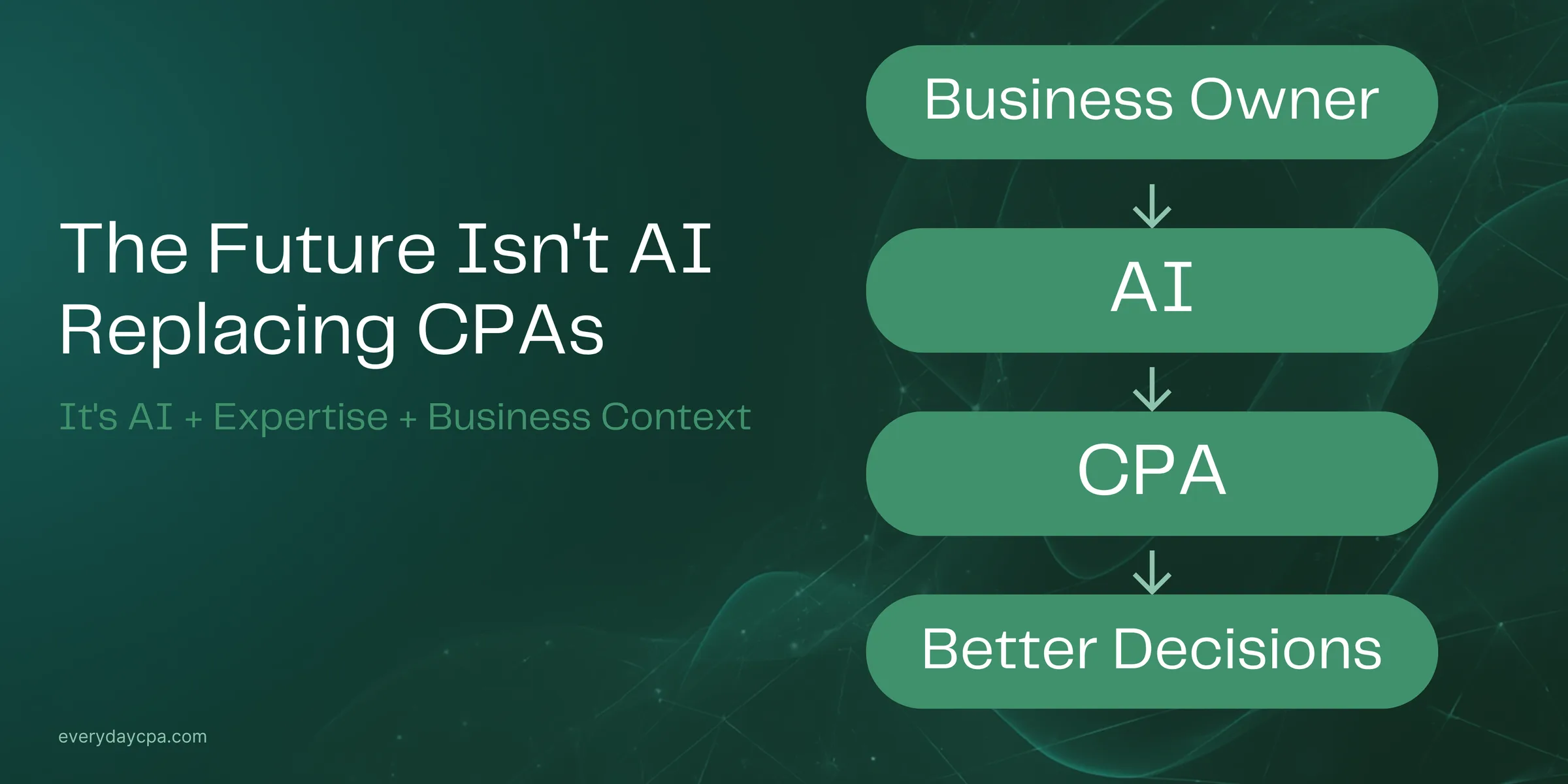
The future of accounting should be a better division of labor.
Each part of the process should be handled by the person or system best suited for that work.
The business owner runs the business.
AI helps compile the financial activity.
Subject matter experts train and review the AI process.
The CPA provides judgment, tax knowledge, and business guidance.
The owner provides confirmation and context.
That is a better structure.
It recognizes that business owners still matter because they know the facts.
It recognizes that AI matters because it can reduce repetitive work.
It recognizes that CPAs still matter because tax and accounting require judgment.
It recognizes that the goal is not simply to produce reports.
The goal is to produce clarity.
This model avoids two bad extremes.
One extreme is owner-do-it-yourself accounting, where the owner carries too much burden and spends too much time doing work he was never trained to do.
The other extreme is AI-only accounting, where software creates output without enough human judgment.
The better path is between those extremes.
AI plus expertise.
The 75 / 15 / 10 Model
Conceptually, we see the future this way:
75% AI-assisted compilation.
15% CPA review, judgment, and guidance.
10% business owner confirmation and context.
The exact percentages may vary by business, but the concept is important.
Most of the repetitive compilation work should not fall on the owner.
AI can help with that.
A smaller but critical portion of the process requires professional review.
That is where CPAs, accountants, tax professionals, and trained advisors apply judgment.
The owner still has a role.
But the owner’s role should be focused and valuable.
The owner should confirm facts, provide business purpose, identify unusual activity, and make decisions with better information.
That 10% owner role still matters.
But it should not require the owner to become a bookkeeper.

Why the Owner’s 10% Still Matters
Some people talk about AI as if the business owner can disappear from the accounting process entirely.
That is not realistic.
The owner knows things AI does not know.
The owner knows whether a transaction was authorized.
The owner knows whether a charge was personal or business.
The owner knows whether a vendor was used for a client project or internal operations.
The owner knows whether a deposit was revenue, a transfer, a loan, or a reimbursement.
The owner knows whether something unusual was legitimate or fraudulent.
The owner knows the business purpose behind decisions.
That knowledge matters.
Without owner context, AI and CPAs may be forced to infer too much.
But the owner should not have to provide context for every routine transaction.
A good system should only ask the owner for the context that actually matters.
That is the key.
The owner should not be buried in accounting work.
The owner should stay connected to the business meaning.
Why CPA Review Still Matters
CPA review matters because financial information has consequences.
It affects tax returns.
It affects estimated tax payments.
It affects cash flow decisions.
It affects profitability analysis.
It affects payroll and contractor reporting.
It affects sales tax, income tax, and business planning.
It affects whether the owner understands what is really happening.
AI can help compile financial data, but the CPA helps determine whether the information is reliable, tax-aware, and useful.
A CPA or trained advisor can review whether deposits are properly classified, transfers are handled correctly, owner payments make sense, large purchases need tax review, contractor payments should be flagged, payroll items are properly recorded, and the reports make business sense.
That review is not a minor add-on.
It is the difference between automation and accountability.
Business owners do not need a system that simply produces more output.
They need a system that produces information they can trust.
Why AI-Assisted Accounting Can Be Better Than Traditional Accounting
AI-assisted accounting can be better than traditional accounting if it is designed correctly.
The traditional model often asks too much of the owner and too little of the system.
The owner collects receipts, categorizes transactions, manages software, answers bookkeeper questions, tries to understand reports, and then waits for tax season to find out what went wrong.
That is inefficient.
AI-assisted accounting can improve the process by reducing repetitive work, identifying issues earlier, organizing data faster, and helping advisors focus on what matters.
But the key phrase is “designed correctly.”
AI-assisted accounting should not mean AI operating alone.
It should mean AI operating inside a framework built by subject matter experts.
That framework should include accounting logic, tax awareness, professional review, owner confirmation, and business decision support.
When that happens, business owners can get better information faster.
CPAs can spend more time applying judgment.
And the entire process can become more useful.
That is the real opportunity.
What This Means for Business Owners
For business owners, the message is simple:
You should not ignore AI.
But you also should not assume AI magically solves your accounting problem.
AI can help reduce the burden.
It can help organize information.
It can help speed up compilation.
It can help create better visibility.
But your business still needs judgment.
You still need to know whether the information is accurate, tax-aware, and useful.
You still need someone to review the results.
You still need your own context included where it matters.
The best financial system will not force you to become the bookkeeper.
It will not leave AI alone to guess.
It will combine automation, expertise, and owner knowledge.
That is how you get financial clarity.
Less accounting work for you.
More useful information.
Better decisions.
What This Means for CPAs
For CPAs, AI is not just a threat.
It is an opportunity to move up the value chain.
If AI can reduce repetitive compilation work, CPAs can spend more time doing the work clients actually need most:
Reviewing.
Interpreting.
Planning.
Advising.
Explaining.
Helping owners make better decisions.
The CPA profession should not define its value by manual data processing.
The value is judgment.
Tax knowledge.
Professional responsibility.
Business guidance.
Understanding how financial information connects to real-world decisions.
AI can make that value more visible if firms use it correctly.
But CPAs cannot simply attach AI to old workflows and call it innovation.
The process needs to be redesigned around clarity.
The client does not just want books.
The client wants to understand the business
Where iPacio Fits
At EverydayCPA, that is the future we are building with iPacio.
iPacio is designed around the idea that business owners should not have to become bookkeepers to get financial clarity.
It is also built around the belief that AI alone is not enough.
The model is not:
Business owner does everything.
And it is not:
AI replaces everyone.
The model is:
AI helps compile the financial activity.
EverydayCPA’s CPA team reviews and interprets the results.
The business owner provides confirmation and context when needed.
Together, the system creates better financial information with less burden on the owner.
That is the practical future.
AI-assisted compilation.
CPA review, judgment, and guidance.
Owner confirmation and context.
Less accounting.
More clarity.
Better decisions.

What Business Owners Should Do Next
The next step is not to panic about AI replacing professionals.
And it is not to trust AI blindly.
The next step is to ask whether your current financial system gives you the clarity you need.
Do you trust your numbers?
Do you know what your tax situation may look like before tax season?
Do you understand your cash flow?
Do you know whether the business is actually profitable?
Do you know where the money is going?
Do you spend too much time doing bookkeeping work?
Do your reports help you make decisions?
If the answer is no, the solution may not be another software tool by itself.
The solution may be a better financial clarity system.
AI can be part of that system.
CPA judgment should be part of that system.
Your business knowledge should be part of that system.
At EverydayCPA, we believe the future is not AI replacing CPAs.
The future is AI plus expertise.
AI plus CPA judgment.
AI plus owner knowledge.
If you want better financial information without becoming the bookkeeper, book a call with Kelly or Cat.
We can help you think through how to reduce the accounting burden and move toward clearer, more useful financial information.

FAQ
Will AI replace CPAs?
AI may replace some repetitive accounting tasks, but it will not fully replace CPA judgment. CPAs provide tax knowledge, professional review, business interpretation, and guidance that AI alone cannot provide.
What accounting tasks can AI help with?
AI can help read transaction data, identify patterns, suggest categories, flag unusual activity, summarize financial information, and reduce repetitive compilation work.
Why is AI alone not enough for accounting?
AI alone is not enough because accounting and tax require judgment, business context, documentation, entity-specific treatment, tax rules, and professional review.
What is AI-assisted accounting?
AI-assisted accounting uses AI to help compile and organize financial activity while professionals review, interpret, and apply accounting and tax judgment.
What is the owner’s role in AI-assisted accounting?
The owner provides confirmation and context. The owner knows whether transactions were authorized, business-related, unusual, personal, reimbursable, or connected to a specific business purpose.
What is the CPA’s role in AI-assisted accounting?
The CPA reviews the financial information, applies tax and accounting judgment, identifies issues, explains what the numbers mean, and helps the business owner make better decisions.
What does 75% AI, 15% CPA, and 10% owner mean?
It is a conceptual model for a better division of labor. AI handles much of the repetitive compilation work, CPAs provide review and judgment, and the business owner confirms key facts and context.
Can AI make accounting cheaper for business owners?
AI may help reduce the time and labor required to compile financial information. But the most valuable result is not just lower cost. It is better financial clarity, faster review, and more useful information.
Should business owners rely on AI bookkeeping?
Business owners can use AI bookkeeping as part of a system, but they should not rely on AI alone. AI bookkeeping should be trained, reviewed, and supported by accounting and tax professionals.
How does iPacio use AI?
iPacio is designed to use AI-assisted compilation, CPA review, and owner confirmation to help business owners get clearer, more tax-aware financial information without becoming bookkeepers.
